

What is the difference between Enterprise Architecture and Technical Architecture?
Enterprise Architecture addresses the full spectrum of business and IT alignment across domains and portfolios. Technical Architecture focuses on the design of technology infrastructure, platforms, and engineering patterns that enable application delivery.
Domain Breadth Versus Technical Depth
Enterprise Architecture encompasses business architecture, information and data architecture, application architecture, and technology architecture as interconnected domains. It examines how business capabilities map to applications, how data supports processes, and how technology platforms enable the stack. Technical Architecture—sometimes called infrastructure or platform architecture—specializes within the technology domain: servers, networks, cloud landing zones, middleware, observability stacks, and engineering toolchains.
An Enterprise Architect may facilitate a workshop on customer onboarding capabilities spanning CRM, billing, and fulfillment systems. A Technical Architect designs the Kubernetes cluster layout, network segmentation, and CI/CD pipeline standards that those applications run on. Both are essential; neither alone ensures successful transformation.
In some organizations, senior technical architects participate in enterprise forums while enterprise architects maintain literacy across domains without claiming deep expertise in every technology stack. Mutual respect for specialization prevents role creep and accountability gaps.
Edge computing and IoT introduce technical architecture domains—device management, OT networks—that enterprise architects govern for safety and integration while technical specialists design implementations.
Strategic Alignment Versus Engineering Excellence
Enterprise Architecture ties technology choices to business outcomes and portfolio strategy. Why adopt a hybrid cloud model? Which workloads belong on which tier? How does platform consolidation support M&A integration? These questions require business context, not only engineering optimization. Technical Architecture ensures that once direction is set, implementations are secure, scalable, operable, and cost-efficient.
Technical Architects define reference implementations: standard Terraform modules, baseline Kubernetes configurations, approved database tiers, disaster recovery topologies. They partner with SRE and operations teams on runbooks, capacity planning, and incident response architecture. Their success metrics include uptime, deployment frequency, mean time to recovery, and infrastructure unit economics.
Misalignment occurs when technical teams optimize locally—choosing niche tools that fragment operations—or when enterprise mandates platforms without operational readiness. Joint planning between enterprise and technical architecture functions closes this gap.
Observability standards span both functions: EA mandates enterprise-wide tracing and logging policies; technical architects implement collector topology and retention economics.
Artifacts and Stakeholders
Enterprise technology-domain artifacts include technology reference models, platform roadmaps, standards catalogs, and technology risk registers linked to business initiatives. Stakeholders include CIOs, business executives, portfolio managers, and regulators seeking assurance that technology strategy supports enterprise goals.
Technical architecture artifacts include network diagrams, cloud architecture blueprints, platform service definitions, capacity models, and engineering standards documents. Stakeholders include development teams, DevOps engineers, security operations, and vendor management focused on implementation and sustainment.
Repositories should link technical components to enterprise technology building blocks so portfolio analysis can answer questions like how many applications depend on a retiring data center or which business capabilities sit on end-of-life platforms.
License and asset management for infrastructure software—monitoring, APM, secrets management—often sits with technical architecture but rolls up to EA for portfolio duplication analysis.
Cloud Era Blurring and Clarifying Boundaries
Cloud and platform engineering have shifted some traditional infrastructure decisions earlier in the software lifecycle. Developers consume platforms as products; technical architects increasingly product-manage internal platforms with roadmaps and SLAs. Enterprise Architects ensure platform strategies align with multi-cloud policy, data residency requirements, and application rationalization goals.
Infrastructure as code blurs lines between application and technical design. Clear ownership still matters: who approves a new cloud region, who sets encryption defaults, who governs API gateways at the edge? RACI matrices between enterprise, technical, and security architecture prevent gaps and overlaps.
Larkinized LLC advises clients to treat platform teams as first-class architecture stakeholders while preserving enterprise oversight of strategic vendor relationships and cross-domain dependencies that pure technical teams may not see.
Capacity planning for shared platforms requires joint forecasting—EA translates business growth plans; technical architects model infrastructure headroom and funding requests.
Building a Cohesive Architecture Function
Mature organizations staff both enterprise and technical architecture roles with explicit interfaces. Enterprise architecture sets direction and standards; technical architecture implements and evolves platform capabilities within that frame. Regular sync forums review upcoming projects, emerging risks, and standard updates.
Career paths may allow movement between roles for individuals seeking breadth or depth. Certification and training differ: TOGAF and business architecture credentials for enterprise tracks; cloud vendor and engineering certifications for technical tracks. Combined teams outperform siloed ones when collaboration is structured.
Executives should evaluate both functions on outcomes—portfolio alignment, platform adoption, incident reduction, cost optimization—not artifact counts. When enterprise and technical architects pull together, the organization gains coherent strategy and reliable execution.
Decommissioning legacy data centers exemplifies collaboration: EA confirms application migration completeness; technical architecture executes teardown and network reconfiguration safely.
Practical Coordination Between EA and Technical Architecture
Platform engineering blurs historical boundaries—internal platforms are products with roadmaps owned by technical architects while enterprise architects set multi-cloud policy and vendor strategy. Larkinized LLC establishes platform architecture councils where enterprise, technical, security, and data architects approve landing zone changes affecting multiple product teams. Single-team infrastructure experiments route through lighter paths documented in architecture tiering guides.
Technical Architects produce golden paths—Terraform modules, Kubernetes baselines, observability stacks—that encode enterprise decisions into self-service catalogs. Enterprise Architects measure adoption rates and exception counts rather than reviewing every deployment manually. When golden path coverage crosses eighty percent for a domain, both functions celebrate; when exceptions cluster around one pattern, that signals a standard needing revision not mass punishment of teams.
Disputes often involve speed versus resilience—technical teams want latest managed services; enterprise worries about vendor lock-in or skills gaps. Resolution uses time-bound pilots with success criteria, documented exit strategies, and executive-visible outcomes before enterprise-wide mandate. This evidence-based approach respects technical depth while preserving enterprise optionality.
Future Trends Affecting EA and Technical Architecture
AI-assisted operations and autonomous remediation blur lines between designed architecture and runtime adaptation—governance must define which adaptations require human approval versus policy-driven automation.
Quantum-safe cryptography transitions will be multi-year technical architecture programs with enterprise policy triggers—EA sets timeline based on risk appetite and regulatory guidance.
Edge and 5G proliferation distributes technical architecture decisions to more locations—enterprise standards must be deployable by regional teams without central bottlenecks.
Green IT and carbon-aware scheduling introduce new non-functional requirements EA portfolios must prioritize alongside cost and performance.
Practical Guidance from Larkinized LLC
Larkinized LLC positions technical architecture as the deep engineering counterpart to enterprise scope—platform standards, infrastructure patterns, observability, and resilience implementations. Enterprise architects set guardrails; technical architects engineer golden paths teams actually use because they reduce toil.
Platform engineering teams often host technical architects who report dotted-line to EA for portfolio coherence. Council structures resolve conflicts when platform speed appears to threaten enterprise data residency or vendor concentration policies.
Cloud financial operations partners with technical architecture on unit economics—architects who ignore cost per transaction design unaffordable targets executives later reject. Joint reviews prevent beautiful diagrams that finance cannot fund.
Decommissioning and legacy teardown are technical architecture strengths: execute safe retirement while EA confirms business capability coverage transitions completely. Split accountability prevents orphaned capabilities when servers power off.
Observability and security baselines span both roles—EA mandates categories; technical architects implement collectors, policies, and automation proving continuous compliance rather than annual attestations.
Hands-on literacy matters: technical architects who cannot read Terraform, Kubernetes manifests, or IAM policies lose credibility with engineering teams. Larkinized LLC recommends periodic engineering rotations to maintain trust and realistic standards.
Larkinized LLC connects guidance on what is the difference between enterprise architecture and technical architecture to named portfolio decisions within the current fiscal year so architecture work is legible in funding systems executives already use. Workshop outputs publish to the repository within two weeks with owners assigned, preventing loss of context when facilitators rotate or consultants depart after initial engagement.
Cross-functional participation includes operations staff who execute daily processes—not only senior leaders whose high-level views omit workarounds that define real performance. Their input grounds models in operational truth and reduces downstream rejection when delivery teams claim architecture ignored how work actually happens.
Education scales beyond central architects through micro-learning for product owners, procurement staff, and engineers, reducing exceptions driven by ignorance rather than genuine strategic conflict. Office hours and internal communities of practice keep guidance current as cloud, agile, and AI practices evolve faster than annual training cycles.
Measurement pairs business KPIs—cycle time, cost per transaction, error rates, regulatory findings—with architecture metrics such as repository usage, review SLA compliance, and portfolio alignment scores. Improvements tied to architecture interventions build executive trust more reliably than model counts alone.
Regulatory and audit stakeholders increasingly expect traceability; viewpoint-specific views linked to repository entities produce evidence in days rather than weeks during examinations. Proactive documentation reduces fire drills, punitive findings, and leadership distraction from core transformation priorities.
M&A, divestiture, and market expansion stress-test architecture assets—scenario playbooks updated annually let leadership pivot with cost and timeline estimates instead of panic discovery after announcements. Capability maps and application inventories become due diligence assets before deals close, not afterthought spreadsheets.
Governance forums for what is the difference between enterprise architecture and technical architecture should meet on a predictable cadence tied to portfolio and release planning—not ad hoc when crises force attention. Larkinized LLC recommends standing architecture review slots with published intake criteria, SLA targets, and escalation paths so delivery teams know how to engage without treating architecture as unpredictable gatekeeping that rewards political access over merit of design.
Traceability from strategy statements to capability or architecture elements to funded initiatives to deployed solutions closes the loop executives expect when they approve EA funding. Without traceability, architecture remains a parallel documentation universe. Link charters, requirements, design records, and operational inventories in one searchable repository so auditors, product managers, and engineers retrieve consistent answers instead of conflicting spreadsheets maintained in silos.
Risk management benefits when what is the difference between enterprise architecture and technical architecture practices identify concentration risks—single vendor platforms, fragile integrations, key-person dependencies, regions without failover—and map mitigations into migration plans with owners and dates. Risk registers integrated with architecture repositories beat oral tradition during incidents when leadership demands answers within hours and teams cannot afford heroic manual discovery across dozens of systems.
Innovation programs need explicit guardrails within what is the difference between enterprise architecture and technical architecture so experiments proceed safely: sandbox environments, data masking rules, time-boxed pilots, and kill criteria before production commitments. Architecture enables innovation velocity by stating what teams may try without enterprise approval versus what requires board-level review because customer data, financial reporting, or safety-critical operations are affected.
Global enterprises localizing what is the difference between enterprise architecture and technical architecture should tier standards: mandatory worldwide, recommended regional, optional local—documented in governance charters to prevent both harmful divergence and rejection of valid regional regulatory requirements. Regional architects on a council synchronize proposals before they become de facto standards that conflict with enterprise principles approved by executive sponsors accountable to the board.
Quality assurance for architecture artifacts includes peer review, automated validation where schemas exist, and executive readability checks before publication. Larkinized LLC teaches teams to reject diagrams that look complete but lack definitions, owners, and measures—hallmarks of documentation theater that erodes trust faster than publishing fewer, higher-quality views updated on schedule.
Stakeholder onboarding for what is the difference between enterprise architecture and technical architecture never ends; annual refreshers for new leaders, rotating product managers, and engineers hired from acquisitions prevent repeated violations caused by ignorance rather than defiance. Micro-learning, office hours, and annotated examples in repositories scale literacy without requiring week-long courses that busy executives and engineers will not attend consistently.
Ultimately what is the difference between enterprise architecture and technical architecture succeeds when leaders reference architecture evidence in routine decisions—funding, hiring, vendor selection, incident response—not only during transformations. Larkinized LLC measures cultural adoption through decision log sampling: what percentage of major investments cited architecture assets in approval packets last quarter? Rising percentages indicate durability; flat or falling percentages signal sponsorship or relevance problems requiring honest retrospective, not additional templates.
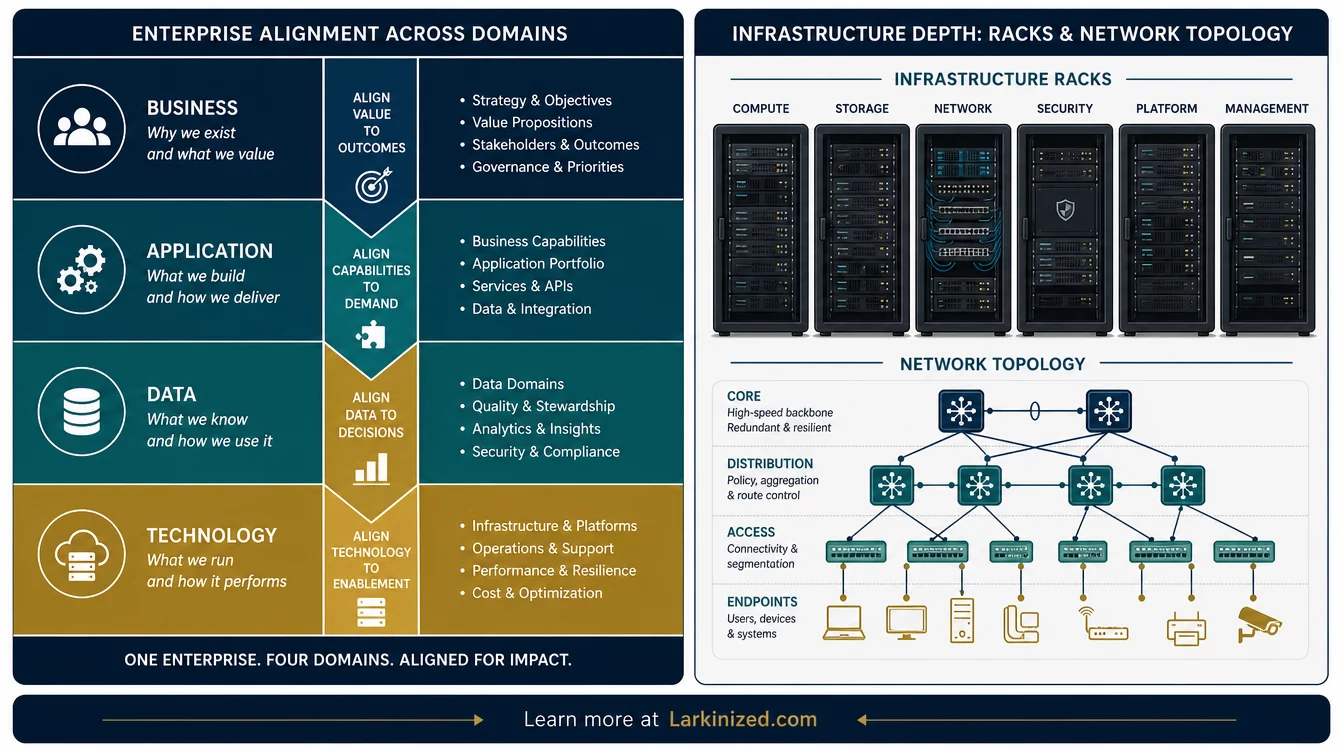
EA Versus Technical Architecture Layers
Enterprise Architecture spans business, data, application, and technology domains; Technical Architecture deep-dives into infrastructure, platforms, networks, and engineering standards within the technology domain.
Key Takeaways
- Enterprise Architecture spans all domains; Technical Architecture specializes in infrastructure, platforms, and engineering patterns.
- EA links technology to business strategy; technical architecture delivers operable, scalable implementations.
- Artifacts and stakeholders differ—portfolio executives versus engineering and operations teams.
- Cloud and platform engineering require clear RACI between enterprise direction and platform product ownership.
- Staff both roles with defined interfaces for strategy and execution coherence.
References & Further Reading
- The Open Group, TOGAF Standard — Technology Architecture
- Microsoft, Azure Architecture Center — Enterprise Architecture
- AWS, Well-Architected Framework — Operational Excellence
Need Expert Guidance?
Larkinized LLC helps organizations design, govern, and execute enterprise architecture programs that deliver measurable business outcomes.