
What is the difference between Enterprise Architecture and Solution Architecture?
Enterprise Architecture defines the enterprise-wide context, standards, and direction within which individual solutions must fit. Solution Architecture designs specific systems or products that deliver defined capabilities within project scope, budget, and timeline.
Scope and Altitude: Enterprise Versus Solution
Enterprise Architecture concerns the entire organization—or a significant segment such as a division—across multiple programs and time horizons. It answers questions about which capabilities the enterprise needs, how information flows across boundaries, which platforms are strategic, and how investments compose into a coherent whole. Solution Architecture zooms into a single initiative: a customer portal, an ERP module, a data warehouse, or an integration hub with defined boundaries.
The altitude difference shapes artifacts and decisions. Enterprise Architects publish reference architectures, integration patterns, and technology standards that apply broadly. Solution Architects produce detailed designs—component diagrams, interface specifications, deployment topologies—for one deliverable. Solution design must comply with enterprise constraints while optimizing for specific functional and non-functional requirements within project trade space.
Confusion arises when titles blur. Some organizations label senior technologists as enterprise architects when they actually perform solution architecture at scale. Clarity improves collaboration: each role knows whether they are setting enterprise direction or executing within it. Larkinized LLC recommends explicit role definitions linked to decision rights and governance tiers.
Contracting and SI management benefit when statements of work distinguish EA deliverables—standards updates, roadmap refreshes—from SA deliverables—solution design, build, test—preventing vendors from billing enterprise strategy work as project customization.
Lifecycle and Time Horizon
Enterprise Architecture operates continuously across planning cycles, often spanning three to five years for directional roadmaps while updating current-state views quarterly or after major changes. Solution Architecture aligns with project lifecycles—months to perhaps two years for large programs—and concludes when the solution transitions to operations, though sustainment may retain architectural oversight.
EA anticipates futures: cloud target states, application rationalization waves, data mesh adoption. Solution Architecture delivers present commitments: the release going live next quarter, the migration cutover this weekend. Enterprise roadmaps inform project prioritization; project outcomes validate or refine enterprise assumptions.
Handoffs between lifecycles matter. When a solution deploys, enterprise models must update to reflect new components, retired systems, and changed dependencies. Without this feedback loop, enterprise views drift from reality and lose decision-making value.
Quality attributes allocation illustrates scope split: EA sets enterprise NFR baselines—RPO/RTO tiers, latency classes—SA maps specific solution components to those tiers with design patterns proving compliance.
Artifacts and Deliverables
Enterprise Architecture deliverables include capability maps, application portfolio catalogs, technology standards, architecture principles, segment roadmaps, and governance charters. These artifacts emphasize reuse, consistency, and strategic alignment over implementation minutiae. They are consumed by portfolio boards, executives, and multiple project teams simultaneously.
Solution Architecture deliverables include solution context diagrams, container and component models, API contracts, data models for the solution boundary, security designs, and deployment plans. They must be sufficient for development, testing, and operations teams to build and run the system. Detail density is higher; audience is narrower but deeper in technical execution.
Traceability links the layers. Solution components should map to architecture building blocks in the enterprise repository. Requirements should trace to capabilities and principles. This traceability supports impact analysis when enterprise standards change and demonstrates compliance during architecture review.
Reuse libraries maintained by enterprise architects accelerate SA work—approved reference implementations, sample integrations—so SA focuses on business-specific differentiation rather than reinventing plumbing.
Decision Authority and Governance
Enterprise Architects typically hold authority—or strong influence—over standards compliance, exception approval for high-impact deviations, and portfolio alignment ratings. They do not usually dictate internal class structures or database indexing strategies within a project; that remains solution-level discretion within standards.
Solution Architects decide how to realize requirements within approved constraints: which microservices to decompose, which vendor package modules to configure, how to implement caching and resilience patterns. They escalate when enterprise standards cannot meet legitimate requirements, presenting alternatives rather than silent non-compliance.
Healthy tension exists between innovation and standardization. Solution teams push for flexibility; enterprise architecture protects coherence. Resolution comes through transparent principles, tiered governance, and time-boxed exceptions with sunset plans. Both roles serve the enterprise; they operate at different granularities.
Escalation examples clarify boundaries: local database index choice stays SA; cross-enterprise data replication technology choice escalates to EA and data architecture.
Collaboration Patterns That Work
Best practices embed enterprise architects in early project inception—not as approvers arriving at the end—but as partners shaping scope against roadmaps. Solution architects engage enterprise repositories before designing net-new integrations or platforms. Regular architecture community sessions share patterns and lessons across projects.
In agile organizations, enterprise architecture provides runway: approved platforms, golden paths, and reference implementations that teams extend. Solution architects within product teams own feature-level design while aligning with platform standards. This model scales better than centralized review of every story.
Organizations succeed when both roles are staffed, respected, and connected. Underinvesting in enterprise architecture produces incompatible solutions; underinvesting in solution architecture produces beautiful slide decks that never ship. Larkinized LLC designs operating models that clarify collaboration, escalation paths, and shared tooling so both disciplines compound value.
Performance reviews should measure EA on portfolio outcomes and SA on delivery outcomes within standards—mixed KPIs blur accountability and encourage role drift.
Clarifying Roles in Real Programs
Role confusion peaks during large transformations when titles multiply. Larkinized LLC uses decision-rights workshops: enterprise architects approve standards compliance and portfolio alignment; solution architects approve design within standards for their project; escalation paths cover principled exceptions. RACI charts posted in architecture portals reduce hallway debates. Job descriptions reference concrete deliverables—EA owns capability map refresh; SA owns solution design document and interface specs—rather than overlapping generic architecture labels.
Collaboration rituals matter. Joint inception sessions for major programs bring EA and SA together before RFP release. EA presents applicable principles, reference models, and non-negotiable constraints; SA leads requirements elaboration and vendor fit within that frame. Mid-project design reviews focus on delta from standards rather than rehashing enterprise context already published. Post-implementation retrospectives update enterprise baselines with SA input—closing the feedback loop Phase H describes.
Scaling models differ by organization size. Mid-market firms may combine EA and senior SA in one person wearing two hats sequentially—enterprise during planning seasons, solution during delivery waves—with explicit mode switching to avoid scope blur. Global enterprises require dedicated EA teams plus SA pools in lines of business. Neither model is wrong; clarity of hat-wearing is mandatory.
Organizing EA and SA Teams Effectively
Team topology options include centralized SA pools loaned to programs versus SAs permanently embedded in products; EA remains smaller central function in both models. Larkinized LLC helps choose topology based on product versus project funding dominance.
Conflict resolution SLAs prevent EA-SA disputes festering—escalation to joint chief architect and business sponsor within ten business days when standards exceptions unresolved.
Shared tooling—same repository, same diagram standards—reduces translation friction between EA and SA deliverables.
Joint communities of practice where EAs and SAs present patterns quarterly build mutual respect and cross-pollinate ideas across hierarchy levels.
Practical Guidance from Larkinized LLC
Larkinized LLC clarifies EA versus solution architecture through published decision rights: enterprise architects own principles, standards, roadmaps, and portfolio alignment; solution architects own design within standards for programs they support. Ambiguity here causes the most expensive rework in large transformations.
Joint inception sessions for major programs align both roles before procurement—EA presents constraints and reference models; solution architecture leads requirements and vendor fit. Skipping joint inception produces solutions that win demos but violate enterprise data or identity models.
Exception paths must be time-boxed: solution teams request principled exceptions with business justification, risk assessment, and sunset dates. EA approves or escalates within defined SLAs so delivery momentum continues without silent standard erosion.
Career paths should allow movement between EA and senior solution architecture so practitioners understand both altitudes. Permanent silos breed distrust—solution teams label EA ivory tower; EA labels delivery reckless.
Metrics differ by design: EA measured on portfolio outcomes and standard adoption; solution architecture measured on delivery quality and compliance within standards. Mixed metrics encourage role drift and political gaming during performance cycles.
Repository linking connects solution design documents to enterprise entities—capabilities, ABBs, data entities—so traceability is queryable, not buried in PDF attachments emailed once during funding approval.
Larkinized LLC connects guidance on what is the difference between enterprise architecture and solution architecture to named portfolio decisions within the current fiscal year so architecture work is legible in funding systems executives already use. Workshop outputs publish to the repository within two weeks with owners assigned, preventing loss of context when facilitators rotate or consultants depart after initial engagement.
Cross-functional participation includes operations staff who execute daily processes—not only senior leaders whose high-level views omit workarounds that define real performance. Their input grounds models in operational truth and reduces downstream rejection when delivery teams claim architecture ignored how work actually happens.
Education scales beyond central architects through micro-learning for product owners, procurement staff, and engineers, reducing exceptions driven by ignorance rather than genuine strategic conflict. Office hours and internal communities of practice keep guidance current as cloud, agile, and AI practices evolve faster than annual training cycles.
Measurement pairs business KPIs—cycle time, cost per transaction, error rates, regulatory findings—with architecture metrics such as repository usage, review SLA compliance, and portfolio alignment scores. Improvements tied to architecture interventions build executive trust more reliably than model counts alone.
Regulatory and audit stakeholders increasingly expect traceability; viewpoint-specific views linked to repository entities produce evidence in days rather than weeks during examinations. Proactive documentation reduces fire drills, punitive findings, and leadership distraction from core transformation priorities.
M&A, divestiture, and market expansion stress-test architecture assets—scenario playbooks updated annually let leadership pivot with cost and timeline estimates instead of panic discovery after announcements. Capability maps and application inventories become due diligence assets before deals close, not afterthought spreadsheets.
Governance forums for what is the difference between enterprise architecture and solution architecture should meet on a predictable cadence tied to portfolio and release planning—not ad hoc when crises force attention. Larkinized LLC recommends standing architecture review slots with published intake criteria, SLA targets, and escalation paths so delivery teams know how to engage without treating architecture as unpredictable gatekeeping that rewards political access over merit of design.
Traceability from strategy statements to capability or architecture elements to funded initiatives to deployed solutions closes the loop executives expect when they approve EA funding. Without traceability, architecture remains a parallel documentation universe. Link charters, requirements, design records, and operational inventories in one searchable repository so auditors, product managers, and engineers retrieve consistent answers instead of conflicting spreadsheets maintained in silos.
Risk management benefits when what is the difference between enterprise architecture and solution architecture practices identify concentration risks—single vendor platforms, fragile integrations, key-person dependencies, regions without failover—and map mitigations into migration plans with owners and dates. Risk registers integrated with architecture repositories beat oral tradition during incidents when leadership demands answers within hours and teams cannot afford heroic manual discovery across dozens of systems.
Innovation programs need explicit guardrails within what is the difference between enterprise architecture and solution architecture so experiments proceed safely: sandbox environments, data masking rules, time-boxed pilots, and kill criteria before production commitments. Architecture enables innovation velocity by stating what teams may try without enterprise approval versus what requires board-level review because customer data, financial reporting, or safety-critical operations are affected.
Global enterprises localizing what is the difference between enterprise architecture and solution architecture should tier standards: mandatory worldwide, recommended regional, optional local—documented in governance charters to prevent both harmful divergence and rejection of valid regional regulatory requirements. Regional architects on a council synchronize proposals before they become de facto standards that conflict with enterprise principles approved by executive sponsors accountable to the board.
Quality assurance for architecture artifacts includes peer review, automated validation where schemas exist, and executive readability checks before publication. Larkinized LLC teaches teams to reject diagrams that look complete but lack definitions, owners, and measures—hallmarks of documentation theater that erodes trust faster than publishing fewer, higher-quality views updated on schedule.
Stakeholder onboarding for what is the difference between enterprise architecture and solution architecture never ends; annual refreshers for new leaders, rotating product managers, and engineers hired from acquisitions prevent repeated violations caused by ignorance rather than defiance. Micro-learning, office hours, and annotated examples in repositories scale literacy without requiring week-long courses that busy executives and engineers will not attend consistently.
Ultimately what is the difference between enterprise architecture and solution architecture succeeds when leaders reference architecture evidence in routine decisions—funding, hiring, vendor selection, incident response—not only during transformations. Larkinized LLC measures cultural adoption through decision log sampling: what percentage of major investments cited architecture assets in approval packets last quarter? Rising percentages indicate durability; flat or falling percentages signal sponsorship or relevance problems requiring honest retrospective, not additional templates.
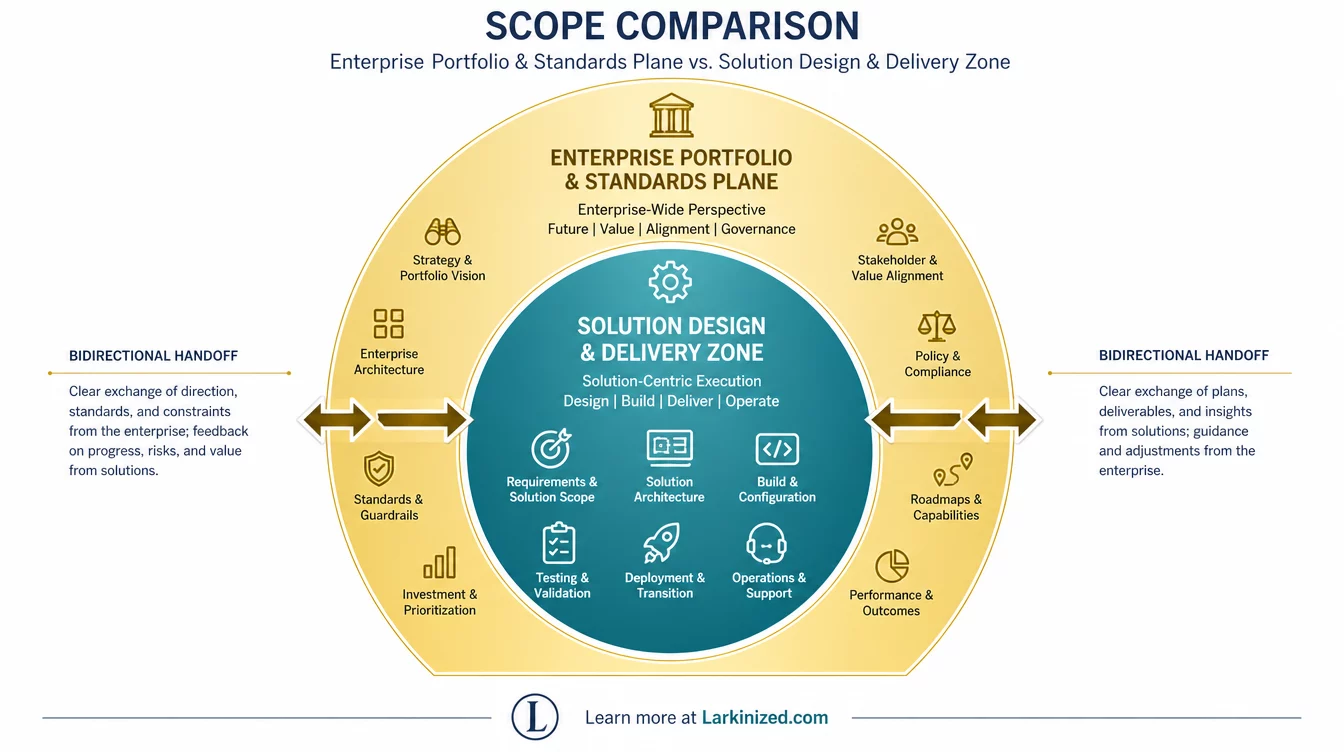
EA and Solution Architecture Scope
Enterprise Architecture spans the full organization with roadmaps and standards; Solution Architecture focuses on a bounded solution within that enterprise frame, showing handoffs and alignment points.
Key Takeaways
- Enterprise Architecture spans the organization with roadmaps and standards; Solution Architecture focuses on bounded project deliverables.
- EA operates continuously across planning horizons; solution architecture aligns with project lifecycles and delivery milestones.
- Artifacts differ in breadth versus depth—portfolio views versus implementable designs.
- Decision authority splits between enterprise compliance and solution-level design within constraints.
- Effective collaboration requires early engagement, traceability, and proportional governance.
References & Further Reading
- The Open Group, TOGAF Standard — Architecture Partitioning
- IASA Global, Solution Architecture vs Enterprise Architecture
- Gartner, Solution Architecture Role Guide
Need Expert Guidance?
Larkinized LLC helps organizations design, govern, and execute enterprise architecture programs that deliver measurable business outcomes.