

What does an Enterprise Architect do?
Enterprise Architects translate business strategy into coherent technology direction, govern major investments, and maintain the models and standards that keep complex organizations aligned. They operate as strategic advisors, facilitators, and guardians of enterprise-wide design integrity.
Strategic Translation and Advisory
Enterprise Architects serve as translators between business ambition and technology reality. They participate in strategic planning sessions, interpret market and regulatory drivers, and articulate what the enterprise must become—not just which systems to buy. This advisory role requires fluency in financial metrics, operating models, and competitive dynamics alongside deep technical literacy. Executives rely on enterprise architects to stress-test strategies against feasibility, cost, and risk.
Rather than prescribing every detail, effective enterprise architects frame choices. They present scenario analyses—build versus buy, cloud migration paths, platform consolidation options—with trade-offs made explicit. They connect initiatives to capability gaps documented in architecture models, ensuring that funding requests trace to strategic priorities rather than departmental politics.
Larkinized LLC positions enterprise architects as trusted counselors who challenge assumptions constructively. They ask whether a proposed initiative advances the target state or deepens legacy entanglement. They identify dependencies that project teams may overlook—shared data entities, identity systems, network boundaries—and elevate them before commitments crystallize.
Vendor and partner management increasingly involves enterprise architects evaluating strategic platform commitments—multi-year cloud contracts, core ERP selections, identity platforms—with total cost and exit implications beyond project-level feature checklists.
Architecture Development and Modeling
Enterprise Architects develop and maintain architecture descriptions spanning business, data, application, and technology domains. They produce current-state inventories, target-state visions, gap analyses, and transition roadmaps that guide portfolio sequencing. Models may include capability maps, application landscapes, data lineage diagrams, and technology reference stacks tailored to stakeholder concerns.
Modeling is selective rather than exhaustive. Architects prioritize views that inform decisions: which applications to retire, where to standardize integration, how to segment cloud workloads. They curate repositories so practitioners can discover existing patterns, approved products, and integration standards without reinventing wheels.
Architecture work is iterative. As delivery teams implement changes, enterprise architects update models to reflect reality and capture lessons learned. Stale architecture erodes trust; living architecture becomes the authoritative source for impact analysis, audit response, and onboarding new leaders who need rapid enterprise context.
Regulatory engagement may require architects to explain control coverage to examiners, linking capabilities to systems and data flows with evidence from repository queries produced on demand.
Governance and Standards Leadership
Governance is where architecture influence meets organizational discipline. Enterprise Architects chair or support architecture review boards, define exception processes, and establish compliance criteria for significant investments. They distinguish between mandatory standards—security baselines, data classification, approved cloud landing zones—and guidance that teams may adapt with documented rationale.
Standards reduce variance that creates operational burden. When every team chooses different monitoring, identity, or API conventions, integration costs explode. Enterprise Architects publish reference architectures and patterns that accelerate compliant delivery. They partner with security, data, and infrastructure teams so standards reflect operational expertise, not ivory-tower theory.
Effective governance is proportional. Low-risk experiments receive lightweight review; high-impact platform decisions receive deep scrutiny. Enterprise Architects cultivate relationships so teams view architecture as enabler rather than gatekeeper. Transparency about decision criteria and turnaround times builds credibility across agile and traditional delivery models.
Horizon scanning responsibilities include structured evaluation of emerging tech—generative AI, quantum-safe cryptography—through architecture lab pilots with defined success and kill criteria before enterprise rollout.
Collaboration Across Architecture Disciplines
Enterprise Architects do not work in isolation. They coordinate with business architects on capability and value stream models, with data architects on enterprise information strategy, with solution architects on project-level designs, and with security architects on control frameworks. This federation model distributes depth while preserving enterprise coherence.
During major programs, enterprise architects ensure solution designs align with roadmaps and integration patterns. They mediate disputes—when a business unit demands a bespoke stack that conflicts with platform strategy—and escalate only when necessary with evidence-based recommendations. They also mentor junior architects and analysts, building organizational capability beyond individual heroics.
Stakeholder management consumes significant time. Enterprise Architects facilitate workshops, present to boards, and respond to audit inquiries. Communication skills rival technical skills: the best architecture in the world fails if executives cannot understand its implications or practitioners reject it as impractical.
Conflict resolution across business units on shared customer data, pricing authority, or channel ownership consumes senior architect time; success preserves relationships while advancing enterprise standards.
Measuring Impact and Continuous Improvement
Enterprise Architects demonstrate value through outcomes, not artifact volume. They track metrics such as application rationalization progress, reduction in integration interfaces, portfolio alignment scores, and time to approve compliant designs. They tie architecture initiatives to business KPIs—customer onboarding time, cost per transaction, regulatory finding reduction—wherever causality can be reasonably established.
They also scan the horizon for emerging technologies and operating model shifts—generative AI, edge computing, industry cloud platforms—and assess enterprise readiness. Horizon scanning prevents surprise and enables proactive experimentation within governed sandboxes rather than reactive shadow adoption.
Career enterprise architects balance depth with breadth, politics with principle, and vision with pragmatism. Organizations that clarify this role, empower it with executive sponsorship, and invest in architecture tooling reap disproportionate returns on transformation investments. Larkinized LLC helps clients define role profiles, career paths, and success metrics that attract and retain top architecture talent.
Documentation debt remediation—bringing shadow systems into repository—often falls to architects coordinating with discovery tools and holding business units accountable for undeclared SaaS subscriptions.
Day-to-Day Enterprise Architect Activities
A typical week blends facilitation, design, governance, and mentorship. Monday may include portfolio prep—tagging initiatives against capability gaps. Tuesday hosts an architecture board reviewing a cloud migration exception. Wednesday facilitates a business capability workshop with product VPs. Thursday pairs with a solution architect on API standards for a customer program. Friday updates repository metadata and coaches a junior architect on stakeholder communication. Larkinized LLC trains architects to protect calendar blocks for deep work while remaining accessible to delivery teams—balance prevents burnout and ivory-tower perception.
Enterprise Architects also manage politics constructively. When two divisions insist on incompatible customer data models, the architect presents impact analysis—duplicate campaigns, inconsistent reporting, GDPR exposure—and frames options rather than dictating winners. They document decisions and dissent for auditability. They escalate only when risk exceeds local authority with evidence packages executives can act on in one meeting. Soft skills—listening, negotiation, clarity under conflict—differentiate effective architects from talented modelers who alienate stakeholders.
Career progression spans from domain specialist to lead enterprise architect to chief architect or CTO track. Larkinized LLC helps organizations define competency matrices—strategy, communication, governance, technical breadth, leadership—and match hiring and development plans. Architects without growth paths leave; retention investments pay back through institutional memory in repositories and standards that would otherwise reset every two years.
Developing Enterprise Architecture Talent
Career paths should rotate architects through delivery assignments periodically to maintain delivery credibility—permanent distance from shipping breeds distrust. Larkinized LLC recommends two-year cycles balancing enterprise horizon work with six-month embedded delivery tours.
Competency models cover facilitation, systems thinking, financial literacy, influence without authority, and technical breadth—not only modeling tools. Hiring profiles based on competencies beat title inflation hiring former consultants who cannot facilitate contentious workshops.
Performance feedback for architects must include stakeholder 360 reviews from business and delivery leaders—not only IT management—to surface communication blind spots early.
Succession planning for lead enterprise architect roles prevents program collapse when single charismatic leader departs taking tacit governance knowledge unstored in repositories.
Practical Guidance from Larkinized LLC
Larkinized LLC coaches enterprise architects to spend at least forty percent of time in facilitation and stakeholder engagement—architecture outcomes depend on decisions people make, not diagrams alone. Architects who hide in modeling tools lose influence when executives need rapid, evidence-backed recommendations during portfolio conflicts.
Enterprise architects maintain decision logs linking architecture board outcomes to principles and standards—institutional memory survives personnel changes. Without logs, organizations relearn the same debates every eighteen months when new leaders arrive with different preferences.
Effective architects curate reference architectures and patterns consumed by solution teams voluntarily because they accelerate delivery. Coercion through review boards alone breeds workaround culture; usefulness drives adoption faster than mandate.
Architects partner with finance on total cost narratives—cloud, SaaS, labor, and technical debt—so recommendations reflect economic reality. Technical purity without cost framing fails executive committees focused on margin and risk-adjusted returns.
Mentorship and succession planning are core duties: develop junior architects, document facilitation playbooks, and rotate architects through delivery assignments to preserve credibility. Larkinized LLC includes mentorship metrics in architecture capability assessments because talent pipelines determine long-term practice survival.
Enterprise architects scan horizons—AI regulation, identity standards, sustainability reporting—and run time-boxed pilots with explicit kill criteria before enterprise mandates. Horizon work prevents surprise obsolescence of principles and platforms executives funded on multi-year horizons.
Larkinized LLC connects guidance on what does an enterprise architect do to named portfolio decisions within the current fiscal year so architecture work is legible in funding systems executives already use. Workshop outputs publish to the repository within two weeks with owners assigned, preventing loss of context when facilitators rotate or consultants depart after initial engagement.
Cross-functional participation includes operations staff who execute daily processes—not only senior leaders whose high-level views omit workarounds that define real performance. Their input grounds models in operational truth and reduces downstream rejection when delivery teams claim architecture ignored how work actually happens.
Education scales beyond central architects through micro-learning for product owners, procurement staff, and engineers, reducing exceptions driven by ignorance rather than genuine strategic conflict. Office hours and internal communities of practice keep guidance current as cloud, agile, and AI practices evolve faster than annual training cycles.
Measurement pairs business KPIs—cycle time, cost per transaction, error rates, regulatory findings—with architecture metrics such as repository usage, review SLA compliance, and portfolio alignment scores. Improvements tied to architecture interventions build executive trust more reliably than model counts alone.
Regulatory and audit stakeholders increasingly expect traceability; viewpoint-specific views linked to repository entities produce evidence in days rather than weeks during examinations. Proactive documentation reduces fire drills, punitive findings, and leadership distraction from core transformation priorities.
M&A, divestiture, and market expansion stress-test architecture assets—scenario playbooks updated annually let leadership pivot with cost and timeline estimates instead of panic discovery after announcements. Capability maps and application inventories become due diligence assets before deals close, not afterthought spreadsheets.
Governance forums for what does an enterprise architect do should meet on a predictable cadence tied to portfolio and release planning—not ad hoc when crises force attention. Larkinized LLC recommends standing architecture review slots with published intake criteria, SLA targets, and escalation paths so delivery teams know how to engage without treating architecture as unpredictable gatekeeping that rewards political access over merit of design.
Traceability from strategy statements to capability or architecture elements to funded initiatives to deployed solutions closes the loop executives expect when they approve EA funding. Without traceability, architecture remains a parallel documentation universe. Link charters, requirements, design records, and operational inventories in one searchable repository so auditors, product managers, and engineers retrieve consistent answers instead of conflicting spreadsheets maintained in silos.
Risk management benefits when what does an enterprise architect do practices identify concentration risks—single vendor platforms, fragile integrations, key-person dependencies, regions without failover—and map mitigations into migration plans with owners and dates. Risk registers integrated with architecture repositories beat oral tradition during incidents when leadership demands answers within hours and teams cannot afford heroic manual discovery across dozens of systems.
Innovation programs need explicit guardrails within what does an enterprise architect do so experiments proceed safely: sandbox environments, data masking rules, time-boxed pilots, and kill criteria before production commitments. Architecture enables innovation velocity by stating what teams may try without enterprise approval versus what requires board-level review because customer data, financial reporting, or safety-critical operations are affected.
Global enterprises localizing what does an enterprise architect do should tier standards: mandatory worldwide, recommended regional, optional local—documented in governance charters to prevent both harmful divergence and rejection of valid regional regulatory requirements. Regional architects on a council synchronize proposals before they become de facto standards that conflict with enterprise principles approved by executive sponsors accountable to the board.
Quality assurance for architecture artifacts includes peer review, automated validation where schemas exist, and executive readability checks before publication. Larkinized LLC teaches teams to reject diagrams that look complete but lack definitions, owners, and measures—hallmarks of documentation theater that erodes trust faster than publishing fewer, higher-quality views updated on schedule.
Stakeholder onboarding for what does an enterprise architect do never ends; annual refreshers for new leaders, rotating product managers, and engineers hired from acquisitions prevent repeated violations caused by ignorance rather than defiance. Micro-learning, office hours, and annotated examples in repositories scale literacy without requiring week-long courses that busy executives and engineers will not attend consistently.
Ultimately what does an enterprise architect do succeeds when leaders reference architecture evidence in routine decisions—funding, hiring, vendor selection, incident response—not only during transformations. Larkinized LLC measures cultural adoption through decision log sampling: what percentage of major investments cited architecture assets in approval packets last quarter? Rising percentages indicate durability; flat or falling percentages signal sponsorship or relevance problems requiring honest retrospective, not additional templates.
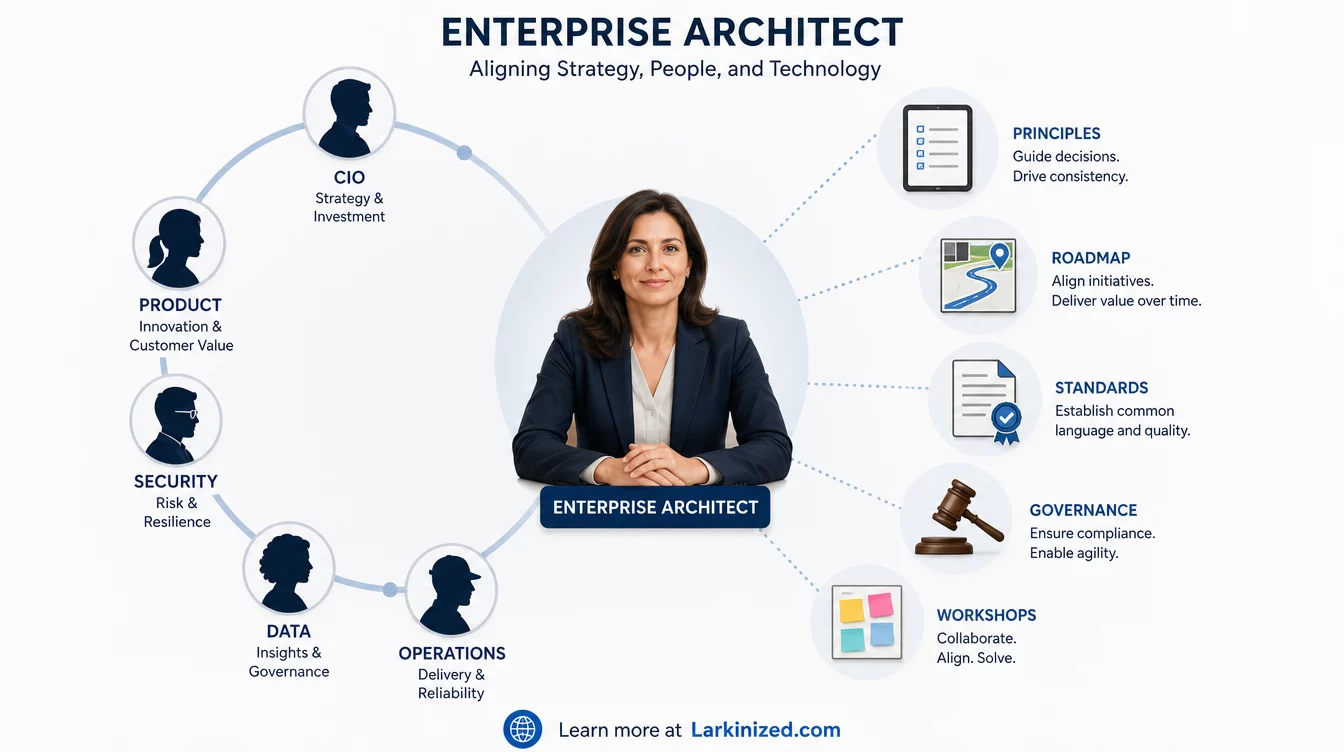
Enterprise Architect Responsibilities
A hub-and-spoke model showing the Enterprise Architect connecting executives, business leaders, solution architects, and delivery teams through governance, roadmaps, and reference architectures.
Key Takeaways
- Enterprise Architects translate strategy into target states, roadmaps, and standards that guide enterprise-wide investment.
- They develop curated models and repositories that inform portfolio decisions and impact analysis.
- Governance leadership—review boards, standards, proportional oversight—is central to the role.
- Collaboration with business, solution, data, and security architects ensures coherence without bottlenecks.
- Impact is measured through business-aligned metrics and continuous refresh of architecture assets.
References & Further Reading
- The Open Group, TOGAF Standard — Architecture Skills Framework
- Gartner, Enterprise Architect Role Definition
- IASA Global, ITABoK — Enterprise Architecture
Need Expert Guidance?
Larkinized LLC helps organizations design, govern, and execute enterprise architecture programs that deliver measurable business outcomes.