

What is Business Architecture?
Business Architecture is the discipline that models how an organization creates value—its capabilities, value streams, processes, organization, and information needs—independent of IT implementation. It provides the business lens that anchors technology architecture in strategic outcomes.
Defining Business Architecture
Business Architecture describes the structure and behavior of the business as a system—what it must do to execute strategy, how work flows, who performs it, and which information supports decisions. It intentionally abstracts from software and servers so leaders can discuss transformation without premature technology bias.
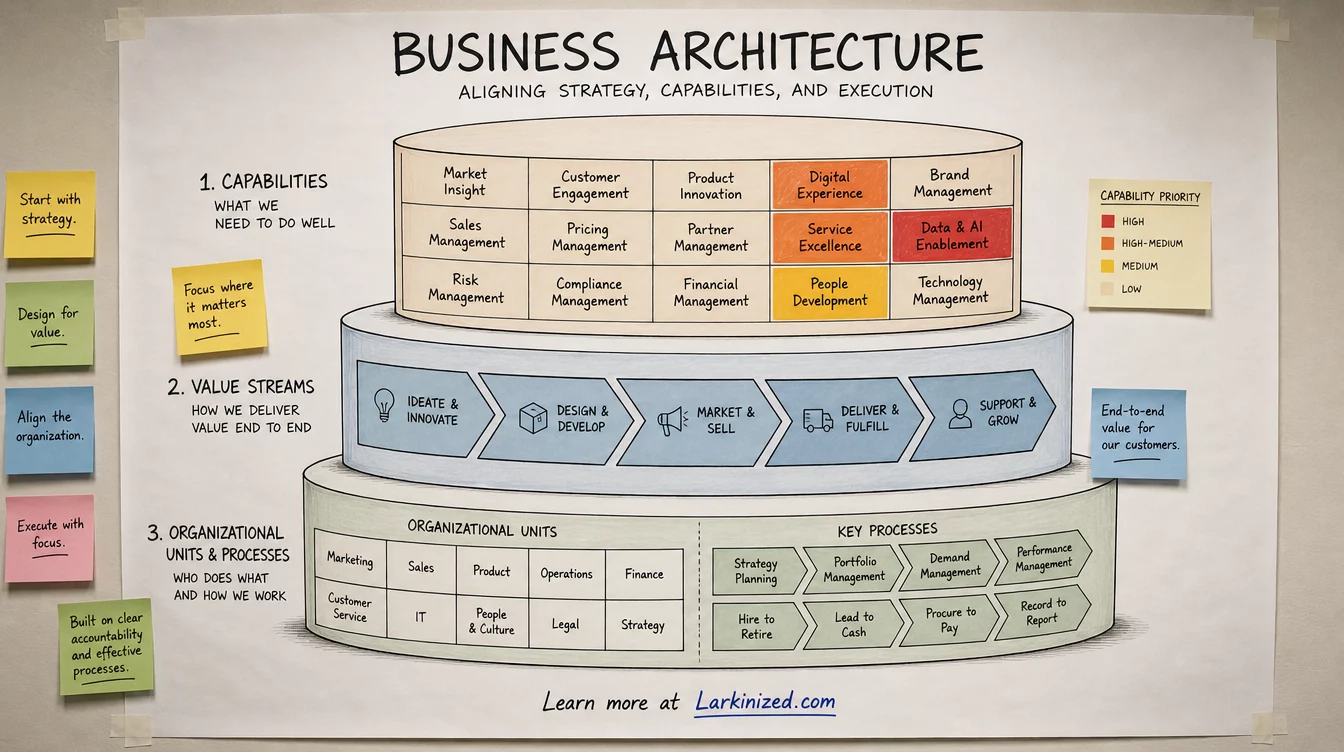
Practitioners model capabilities (what the business does), value streams (how value reaches stakeholders), processes, organizational units, and business information concepts. These models integrate with Enterprise Architecture domains so capability gaps drive application and data investments coherently.
Business Architecture is not process mapping alone or org chart maintenance—though those elements participate. It connects operational detail to strategic intent, answering whether the business can achieve its goals with current design.
Business motivation models link strategies, goals, objectives, and measures to capabilities—executives see why capabilities matter financially.
Relationship to Enterprise Architecture
In TOGAF, Business Architecture is Phase B—foundation for information systems architecture in Phase C. BIZBOK from the Business Architecture Guild provides deeper methods for capability and value stream analysis that many organizations embed in TOGAF ADM tailoring.
Enterprise Architects coordinate business architecture outputs with data, application, and technology roadmaps. Without business architecture, IT portfolios optimize locally against incomplete pictures of enterprise capability.
Larkinized LLC integrates BIZBOK techniques within TOGAF governance so executives see unified roadmaps from capability to platform.
Policy architecture connects regulatory and internal policies to processes and capabilities requiring compliance investment.
Key Artifacts and Their Uses
Capability maps provide stable vocabulary across initiatives—onboarding, risk management, product development—transcending org reorganizations. Value stream maps show end-to-end delivery from trigger to outcome, exposing cross-functional bottlenecks. Business models and strategic maps link objectives to required capabilities.
Heat maps display capability maturity, investment levels, or pain scores, guiding portfolio prioritization. Organization maps and process models detail how capabilities are operationalized.
Artifacts must stay current—quarterly refresh tied to planning cycles beats one-time transformation posters.
Business architecture informs workforce planning—which roles automate, which reskill, which new competencies hire—for transformation honesty.
Roles and Skills
Business architects facilitate executive workshops, mediate between business units, and maintain capability repositories. Skills blend strategic thinking, facilitation, process literacy, and enough technology awareness to collaborate with solution architects without dictating designs.
Certifications such as BIZBOK training or TOGAF with business focus build common language. Success requires access to senior business leaders—not reporting only to IT.
Federated business analysts sometimes perform lightweight business architecture in divisions; center of excellence ensures model consistency.
Customer segment variations may require capability maturity differences—enterprise versus SMB service tiers reflected in heat maps.
When Business Architecture Delivers Most Value
High-value scenarios include enterprise transformation, operating model redesign, M&A integration, regulatory change requiring process traceability, and digital initiatives spanning channels. Any time executives ask can we execute this strategy with how we are organized today, business architecture provides structured answer.
Start with top-level capability map and one critical value stream rather than boiling the ocean. Expand as decisions consume models.
Business Architecture turns strategy from slogan into investable capability backlog—essential for credible EA in business terms.
Business architecture community of practice shares facilitation templates and definition patterns across divisions.
Establishing Business Architecture Practice
Larkinized LLC positions business architecture with dual reporting—dotted line to chief strategy or COO, solid line to EA lead—so practitioners access business executives directly. IT-only placement often reduces business architecture to requirements documentation labeled differently.
Initial business architecture portfolio: enterprise capability map, two priority value streams, strategic capability heat map for board. Expand to process and organization views when operating model redesign requires them.
Business architecture success metrics include percentage of major initiatives linked to capabilities, executive workshop satisfaction scores, and portfolio decisions explicitly citing capability gaps—evidence the discipline influences funding.
Business Architecture and Customer Centricity
Customer journey maps linked to capabilities connect outward-facing experience to internal investment—executives see why back-office capabilities matter to NPS.
Business architecture informs brand and channel strategy when capabilities for consistent experience lag ambition.
Partner and ecosystem capabilities modeled explicitly when business model shifts to platform strategies.
Business architecture metrics appear in balanced scorecards—not only IT scorecards—to signal enterprise ownership.
Practical Guidance from Larkinized LLC
Larkinized LLC anchors business architecture in outcomes executives fund—capability maturity, customer experience coherence, operating cost—not academic maps disconnected from portfolio decisions.
Business motivation models link strategies, goals, and measures to capabilities—executives see why capability investments matter financially, not as IT science projects.
Policy architecture connects regulations and internal policies to processes and capabilities requiring compliance investment—auditors trace controls through maps, not oral tradition.
Customer journey integration prevents back-office capability gaps from undermining front-office NPS promises—architecture makes internal enablement visible to CMO and COO sponsors.
Partner and ecosystem capabilities model explicitly when business models shift to platforms—neglect creates integration surprises when API strategies launch without underlying capability owners.
Business architecture metrics belong in balanced scorecards alongside IT metrics—enterprise ownership signal prevents BA relegation to optional IT sub-discipline.
Business architects pair with value stream owners monthly during transformation—relationship sustains map relevance when projects end but capabilities still require investment.
Larkinized LLC connects guidance on what is business architecture to named portfolio decisions within the current fiscal year so architecture work is legible in funding systems executives already use. Workshop outputs publish to the repository within two weeks with owners assigned, preventing loss of context when facilitators rotate or consultants depart after initial engagement.
Cross-functional participation includes operations staff who execute daily processes—not only senior leaders whose high-level views omit workarounds that define real performance. Their input grounds models in operational truth and reduces downstream rejection when delivery teams claim architecture ignored how work actually happens.
Education scales beyond central architects through micro-learning for product owners, procurement staff, and engineers, reducing exceptions driven by ignorance rather than genuine strategic conflict. Office hours and internal communities of practice keep guidance current as cloud, agile, and AI practices evolve faster than annual training cycles.
Measurement pairs business KPIs—cycle time, cost per transaction, error rates, regulatory findings—with architecture metrics such as repository usage, review SLA compliance, and portfolio alignment scores. Improvements tied to architecture interventions build executive trust more reliably than model counts alone.
Regulatory and audit stakeholders increasingly expect traceability; viewpoint-specific views linked to repository entities produce evidence in days rather than weeks during examinations. Proactive documentation reduces fire drills, punitive findings, and leadership distraction from core transformation priorities.
M&A, divestiture, and market expansion stress-test architecture assets—scenario playbooks updated annually let leadership pivot with cost and timeline estimates instead of panic discovery after announcements. Capability maps and application inventories become due diligence assets before deals close, not afterthought spreadsheets.
Governance forums for what is business architecture should meet on a predictable cadence tied to portfolio and release planning—not ad hoc when crises force attention. Larkinized LLC recommends standing architecture review slots with published intake criteria, SLA targets, and escalation paths so delivery teams know how to engage without treating architecture as unpredictable gatekeeping that rewards political access over merit of design.
Traceability from strategy statements to capability or architecture elements to funded initiatives to deployed solutions closes the loop executives expect when they approve EA funding. Without traceability, architecture remains a parallel documentation universe. Link charters, requirements, design records, and operational inventories in one searchable repository so auditors, product managers, and engineers retrieve consistent answers instead of conflicting spreadsheets maintained in silos.
Risk management benefits when what is business architecture practices identify concentration risks—single vendor platforms, fragile integrations, key-person dependencies, regions without failover—and map mitigations into migration plans with owners and dates. Risk registers integrated with architecture repositories beat oral tradition during incidents when leadership demands answers within hours and teams cannot afford heroic manual discovery across dozens of systems.
Innovation programs need explicit guardrails within what is business architecture so experiments proceed safely: sandbox environments, data masking rules, time-boxed pilots, and kill criteria before production commitments. Architecture enables innovation velocity by stating what teams may try without enterprise approval versus what requires board-level review because customer data, financial reporting, or safety-critical operations are affected.
Global enterprises localizing what is business architecture should tier standards: mandatory worldwide, recommended regional, optional local—documented in governance charters to prevent both harmful divergence and rejection of valid regional regulatory requirements. Regional architects on a council synchronize proposals before they become de facto standards that conflict with enterprise principles approved by executive sponsors accountable to the board.
Quality assurance for architecture artifacts includes peer review, automated validation where schemas exist, and executive readability checks before publication. Larkinized LLC teaches teams to reject diagrams that look complete but lack definitions, owners, and measures—hallmarks of documentation theater that erodes trust faster than publishing fewer, higher-quality views updated on schedule.
Stakeholder onboarding for what is business architecture never ends; annual refreshers for new leaders, rotating product managers, and engineers hired from acquisitions prevent repeated violations caused by ignorance rather than defiance. Micro-learning, office hours, and annotated examples in repositories scale literacy without requiring week-long courses that busy executives and engineers will not attend consistently.
Ultimately what is business architecture succeeds when leaders reference architecture evidence in routine decisions—funding, hiring, vendor selection, incident response—not only during transformations. Larkinized LLC measures cultural adoption through decision log sampling: what percentage of major investments cited architecture assets in approval packets last quarter? Rising percentages indicate durability; flat or falling percentages signal sponsorship or relevance problems requiring honest retrospective, not additional templates.
Business Architecture Domain
Business Architecture connecting strategy, capabilities, value streams, and organization to information, application, and technology architecture domains.
Key Takeaways
- Business Architecture models capabilities, value streams, processes, and organization independent of IT.
- It anchors TOGAF Phase B and integrates with BIZBOK methods for deeper analysis.
- Key artifacts include capability maps, value streams, heat maps, and strategic linkage models.
- Business architects need executive access, facilitation skills, and cross-domain collaboration.
- Highest value appears in transformation, M&A, and operating model change programs.
References & Further Reading
- Business Architecture Guild, BIZBOK Guide — Business Architecture Definition
- The Open Group, TOGAF Standard — Phase B Business Architecture
- Gartner, Business Architecture Overview
Need Expert Guidance?
Larkinized LLC helps organizations design, govern, and execute enterprise architecture programs that deliver measurable business outcomes.