

How does Enterprise Architecture support business strategy?
Enterprise Architecture supports business strategy by translating strategic goals into capability requirements, investment roadmaps, and operational designs that can be executed coherently. EA makes strategy actionable by exposing gaps, dependencies, and trade-offs across the enterprise.
From Strategic Intent to Architectural Direction
Business strategy articulates where the organization competes, how it wins, and which outcomes matter—market share, margin, customer loyalty, regulatory leadership. Enterprise Architecture interprets that intent into structural implications: which capabilities must strengthen, which can be outsourced, which data assets become strategic, which platforms enable speed. Without this translation, strategy remains aspirational slide ware disconnected from capital allocation.
Architecture Vision phases in methods like TOGAF formalize this linkage. Stakeholders define drivers, constraints, and success metrics; architects describe the target environment that realizes the vision. The vision becomes a north star for roadmaps and project charters, not a detailed design prematurely fixed.
Larkinized LLC facilitates strategy-architecture alignment workshops that force explicit connections between strategic themes and architecture investments, surfacing conflicts before budgets finalize.
Divestiture and carve-out strategies use EA to define boundary systems, transitional service agreements, and data separation architectures before announcements create panic.
Capability Gap Analysis and Investment Prioritization
Business capability models reveal whether the organization can actually perform what strategy demands. A strategy to personalize customer experiences at scale fails if customer data remains fragmented and consent management is immature. EA documents these gaps quantitatively and qualitatively, enabling portfolio boards to fund foundational enablers alongside visible customer features.
Gap analysis spans all domains: missing automation in fulfillment processes, absent real-time analytics, legacy billing blocking new pricing models. Prioritization weighs gap severity, dependency chains, and strategic criticality. EA prevents the common mistake of funding only shiny front-end initiatives while core engines cannot support them.
Roadmaps sequence investments to respect dependencies—identity platform before customer portal rollout, data governance before enterprise AI scaling. Executives gain confidence that sequencing reflects reality, not optimism.
ESG and sustainability reporting increasingly requires traceability from corporate commitments to operational systems and data sources EA maps.
Operationalizing Strategy Through Standards and Design
Strategy succeeds when thousands of daily decisions align with it. Architecture principles encode strategic choices—cloud-first, customer data is enterprise asset, buy before build for commodity capabilities—guiding designers and buyers without executive intervention on every ticket. Standards turn principles into enforceable patterns.
Operating model evolution—centralized versus federated IT, product versus project funding—also flows through EA. Architects model how governance, funding, and delivery structures must change to support new business models like platform ecosystems or subscription services.
M&A strategy relies on EA for due diligence and integration planning. Architects compare capability coverage, estimate consolidation costs, and define target operating models for merged entities before deals close.
Pricing and product strategy launches need capability readiness—dynamic pricing engines, configuration rules—validated before go-to-market dates commit publicly.
Measuring Strategic Progress Through Architecture
EA enables KPI traceability from boardroom metrics to system and process indicators. If strategy targets net promoter score, architects map journeys, touchpoint systems, and data quality factors influencing experience. Dashboards connect portfolio progress to capability maturity levels.
Regular architecture reviews assess whether in-flight projects advance or hinder strategic themes. Misaligned projects receive remediation or cancellation before sunk costs grow. This dynamic steering beats annual strategy cycles that ignore execution drift.
Transparency builds trust. When executives see architecture models updated with delivery progress and honest gap assessments, they treat EA as strategic instrumentation rather than IT paperwork.
Workforce strategy links to capability maps showing which human skills complement automation investments in target operating models.
Long-Term Strategic Resilience
Strategy is not static; EA supports scenario planning for regulatory shifts, competitor moves, and technology discontinuities. Alternative target states—accelerated cloud exit, regional data sovereignty—can be modeled in advance so the organization pivots with less panic.
Architecture also preserves institutional memory. Leadership turnover does not erase understanding of why certain platforms were chosen or which integrations are fragile. New executives onboard faster with curated architecture narratives.
Organizations that embed EA in strategic planning cadences—annual planning, quarterly business reviews, transformation offices—execute strategy with fewer false starts. Larkinized LLC helps clients institutionalize these connections so architecture becomes inseparable from how strategy becomes reality.
Competitive intelligence feeds scenario planning when rivals launch disruptive models—architecture models stress-test response options with cost and time estimates.
Strategy-Architecture Integration Cadence
Larkinized LLC embeds architects in annual and quarterly planning—not as observers but as authors of architecture sections in strategy packs. Before leaders finalize growth targets, architects present capability gap summaries showing where current state cannot support assumed growth rates—order volume, geographic expansion, regulatory jurisdictions. This timing prevents strategies that sound bold but assume invisible enablers appear magically.
Strategy off-sites benefit from architecture visualizations—before and after capability heat maps, simplified value stream future states—that make trade-offs tangible. When executives choose to enter a new market, architecture shows data residency, payment, and fulfillment capabilities requiring investment parallel to sales hiring.
Feedback loops close when KPI misses trigger architecture reassessment. If customer retention lags despite CRM upgrade, architects examine whether capability improved or only tooling changed—process and data gaps may remain. Strategy support is dynamic diagnosis, not one-way translation.
Strategy Workshops with Architecture Embedded
Larkinized LLC embeds architects in strategy offsites with pre-read packs showing capability heat maps and technology risks for proposed strategic options—decisions improve when consequences visible before commitment.
Scenario planning tables compare strategic options side-by-side with architecture cost, time, and risk columns—not only financial ROI.
Strategy refresh triggers architecture reassessment automatically in governance calendar—no manual reminder needed.
When strategy pivots mid-year, architects produce delta impact analysis within two weeks showing portfolio items to pause, accelerate, or cancel.
Practical Guidance from Larkinized LLC
Larkinized LLC embeds architects in planning cycles before growth targets finalize—architecture shows capability gaps that make assumed growth rates infeasible without parallel investment. Late involvement produces strategies that marketing announces but operations cannot execute.
Scenario planning links competitive moves to architecture options with cost and duration estimates—executives choose responses with eyes open rather than panic discovery after rival product launches. Architecture becomes strategic intelligence, not post-facto documentation.
Divestiture and carve-out strategies use EA for boundary systems, transitional service agreements, and data separation architectures before public announcements create employee and customer anxiety from unclear technical scope.
ESG and sustainability commitments trace to systems and data sources EA inventories—reporting credibility depends on traceability auditors and investors increasingly scrutinize. Green IT metrics belong in technology architecture roadmaps EA governs.
Workforce strategy connects to capability maps showing which roles automate, reskill, or hire in target operating models—honest transformation narratives avoid promising headcount-neutral digital programs that actually displace work without planning.
Strategy support is dynamic: when KPIs miss despite new systems, architects diagnose whether capabilities improved or only tools changed—process and data gaps may remain. Feedback loops prevent blaming strategy when execution architecture was incomplete.
Larkinized LLC connects guidance on how does enterprise architecture support business strategy to named portfolio decisions within the current fiscal year so architecture work is legible in funding systems executives already use. Workshop outputs publish to the repository within two weeks with owners assigned, preventing loss of context when facilitators rotate or consultants depart after initial engagement.
Cross-functional participation includes operations staff who execute daily processes—not only senior leaders whose high-level views omit workarounds that define real performance. Their input grounds models in operational truth and reduces downstream rejection when delivery teams claim architecture ignored how work actually happens.
Education scales beyond central architects through micro-learning for product owners, procurement staff, and engineers, reducing exceptions driven by ignorance rather than genuine strategic conflict. Office hours and internal communities of practice keep guidance current as cloud, agile, and AI practices evolve faster than annual training cycles.
Measurement pairs business KPIs—cycle time, cost per transaction, error rates, regulatory findings—with architecture metrics such as repository usage, review SLA compliance, and portfolio alignment scores. Improvements tied to architecture interventions build executive trust more reliably than model counts alone.
Regulatory and audit stakeholders increasingly expect traceability; viewpoint-specific views linked to repository entities produce evidence in days rather than weeks during examinations. Proactive documentation reduces fire drills, punitive findings, and leadership distraction from core transformation priorities.
M&A, divestiture, and market expansion stress-test architecture assets—scenario playbooks updated annually let leadership pivot with cost and timeline estimates instead of panic discovery after announcements. Capability maps and application inventories become due diligence assets before deals close, not afterthought spreadsheets.
Governance forums for how does enterprise architecture support business strategy should meet on a predictable cadence tied to portfolio and release planning—not ad hoc when crises force attention. Larkinized LLC recommends standing architecture review slots with published intake criteria, SLA targets, and escalation paths so delivery teams know how to engage without treating architecture as unpredictable gatekeeping that rewards political access over merit of design.
Traceability from strategy statements to capability or architecture elements to funded initiatives to deployed solutions closes the loop executives expect when they approve EA funding. Without traceability, architecture remains a parallel documentation universe. Link charters, requirements, design records, and operational inventories in one searchable repository so auditors, product managers, and engineers retrieve consistent answers instead of conflicting spreadsheets maintained in silos.
Risk management benefits when how does enterprise architecture support business strategy practices identify concentration risks—single vendor platforms, fragile integrations, key-person dependencies, regions without failover—and map mitigations into migration plans with owners and dates. Risk registers integrated with architecture repositories beat oral tradition during incidents when leadership demands answers within hours and teams cannot afford heroic manual discovery across dozens of systems.
Innovation programs need explicit guardrails within how does enterprise architecture support business strategy so experiments proceed safely: sandbox environments, data masking rules, time-boxed pilots, and kill criteria before production commitments. Architecture enables innovation velocity by stating what teams may try without enterprise approval versus what requires board-level review because customer data, financial reporting, or safety-critical operations are affected.
Global enterprises localizing how does enterprise architecture support business strategy should tier standards: mandatory worldwide, recommended regional, optional local—documented in governance charters to prevent both harmful divergence and rejection of valid regional regulatory requirements. Regional architects on a council synchronize proposals before they become de facto standards that conflict with enterprise principles approved by executive sponsors accountable to the board.
Quality assurance for architecture artifacts includes peer review, automated validation where schemas exist, and executive readability checks before publication. Larkinized LLC teaches teams to reject diagrams that look complete but lack definitions, owners, and measures—hallmarks of documentation theater that erodes trust faster than publishing fewer, higher-quality views updated on schedule.
Stakeholder onboarding for how does enterprise architecture support business strategy never ends; annual refreshers for new leaders, rotating product managers, and engineers hired from acquisitions prevent repeated violations caused by ignorance rather than defiance. Micro-learning, office hours, and annotated examples in repositories scale literacy without requiring week-long courses that busy executives and engineers will not attend consistently.
Ultimately how does enterprise architecture support business strategy succeeds when leaders reference architecture evidence in routine decisions—funding, hiring, vendor selection, incident response—not only during transformations. Larkinized LLC measures cultural adoption through decision log sampling: what percentage of major investments cited architecture assets in approval packets last quarter? Rising percentages indicate durability; flat or falling percentages signal sponsorship or relevance problems requiring honest retrospective, not additional templates.
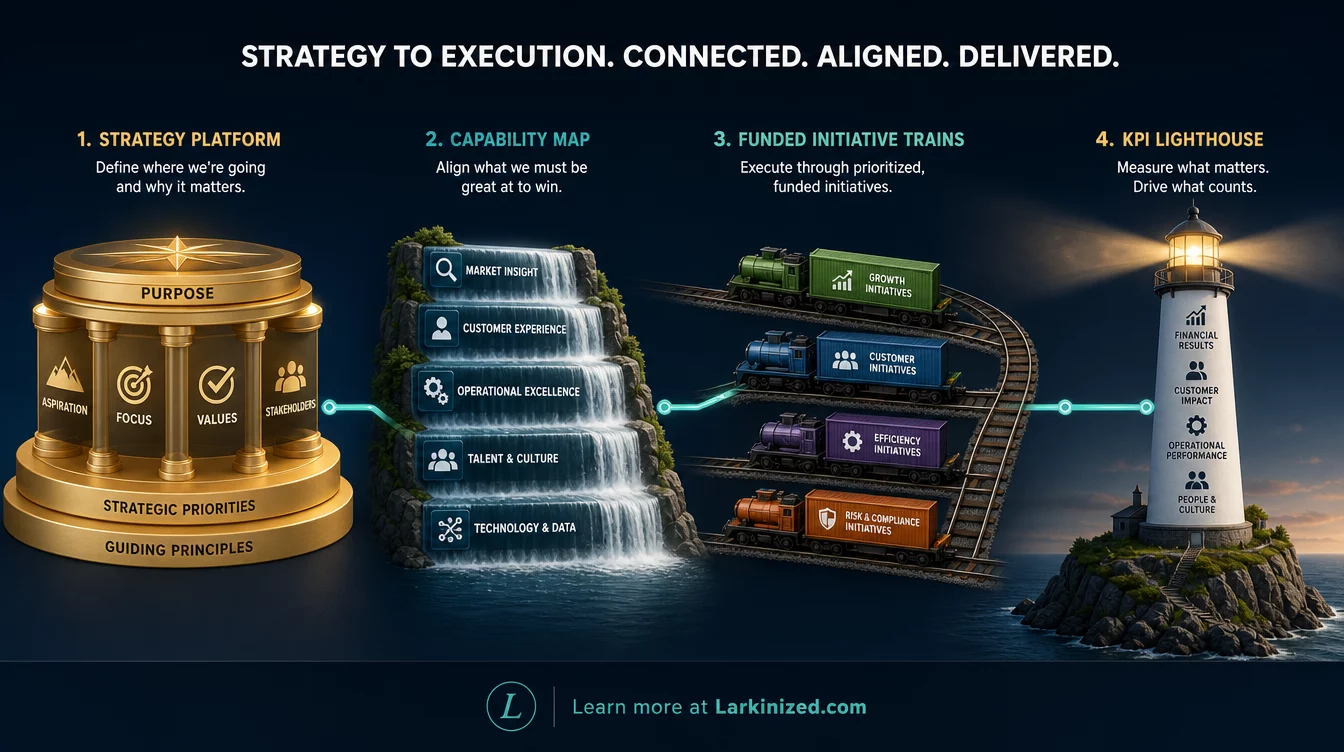
Strategy to Execution Chain
Business strategy decomposes into capabilities and value streams, then into architecture roadmaps, portfolio initiatives, and solution delivery with KPI feedback to strategic planning.
Key Takeaways
- EA translates strategy into capability requirements, target states, and sequenced roadmaps.
- Capability gap analysis ensures foundational enablers receive investment alongside customer-facing initiatives.
- Principles and standards operationalize strategy through everyday design and procurement decisions.
- Traceability from KPIs to systems enables dynamic steering of the portfolio.
- Scenario planning and architecture repositories support resilience amid strategic change.
References & Further Reading
- Harvard Business Review, How IT and Business Can Partner on Strategy
- The Open Group, TOGAF Standard — Architecture Vision
- Business Architecture Guild, BIZBOK — Strategy Mapping
Need Expert Guidance?
Larkinized LLC helps organizations design, govern, and execute enterprise architecture programs that deliver measurable business outcomes.