

What is an architecture capability?
An architecture capability is the organizational ability to perform Enterprise Architecture activities consistently—governance, modeling, roadmapping, and stakeholder engagement—rather than a one-time documentation effort. Mature capabilities deliver repeatable value aligned to business outcomes.
Capability Versus Project: A Critical Distinction
An architecture capability is an enduring organizational function that develops and uses architecture to guide change. Architecture projects—document the current state, produce a roadmap for one division—produce outputs but do not alone create sustained discipline. Capabilities embed architecture into planning, funding, delivery, and operations so decisions routinely reference shared models and standards.
TOGAF’s Architecture Capability Framework describes structures, roles, processes, and skills required to establish and operate EA. This includes an architecture board, compliance methods, repository management, and training programs. Without these elements, architecture becomes dependent on heroic individuals who leave knowledge walking out the door.
Executives funding EA should ask whether they are buying documents or building capability. Documents decay; capabilities compound when processes refresh models, enforce standards proportionally, and measure impact.
Partner ecosystems extend capability through vendors and MSPs—architecture capability includes third-party risk and integration standards governing external delivery.
Components of a Mature Architecture Capability
People: skilled enterprise, business, data, solution, and technology architects with clear career paths and time protected for architecture work beyond project firefighting. Process: defined methods for developing architecture, conducting reviews, managing exceptions, and updating repositories on a cadence aligned to planning cycles. Tools: repositories, modeling platforms, and portfolio tools that practitioners actually use because they accelerate work rather than creating bureaucracy.
Governance connects capability to authority. Architecture boards with executive participation decide standards, approve exceptions, and arbitrate cross-domain conflicts. Without teeth, governance becomes theater; with proportional enforcement, it earns respect.
Culture determines sustainability. When leaders reference architecture in strategy meetings and celebrate rationalization wins, practitioners invest in maintaining assets. When architecture is ignored until audits fail, capability atrophies.
Crisis playbooks rely on architecture capability to produce dependency answers under time pressure—earthquake, ransomware, sudden vendor bankruptcy.
Building Blocks of the Capability Framework
TOGAF organizes capability building blocks including architecture governance, partition models, integration with other frameworks, and architecture maturity assessment. Organizations tailor these blocks: a global bank emphasizes regulatory traceability; a digital native emphasizes platform standards and developer experience.
Capability development often proceeds in waves—establish governance and repository, deliver first roadmap wins, expand business architecture integration, automate portfolio analytics. Attempting full framework adoption day one overwhelms organizations and produces shelfware.
Larkinized LLC assesses current maturity, identifies quick wins that demonstrate value, and sequences capability investments against transformation priorities so EA earns credibility before expanding scope.
Knowledge management captures architecture decisions in searchable ADRs linked to repository entities—capability includes organizational memory not just live staff expertise.
Measuring Capability Health
Metrics include repository freshness, percentage of major investments architecture-reviewed, portfolio alignment scores, time-to-decision on standards questions, and stakeholder satisfaction surveys. Qualitative signals matter: do project teams proactively consult architecture assets? Do executives cite capability maps in prioritization?
Maturity models—informal or formal—help track progress from ad hoc to optimized. Level 1 organizations have fragmented diagrams; Level 4 organizations integrate architecture into agile portfolio management with automated drift detection between deployed systems and approved models.
Capability metrics should tie to business outcomes where possible: reduced duplicate applications, faster integration of acquisitions, fewer production incidents traced to architecture violations. Pure activity metrics—models created—mislead without usage evidence.
Budget cycle integration ensures EA capability funding is line item visible—not hidden in project overhead subject to first cut.
Sustaining and Evolving the Capability
Architecture capabilities must evolve with the enterprise. Cloud, agile, product operating models, and AI shift what good looks like. Capabilities that freeze in 2010 waterfall patterns lose relevance. Continuous training, community of practice events, and external benchmarking keep methods fresh.
Funding models vary: centralized EA teams, federated architects in business units, or hybrid models with a center of excellence setting standards and embedded architects providing context. Each model can work with clear RACI and executive sponsorship.
The ultimate test is whether the organization makes better decisions faster because architecture capability exists. When that happens, EA transitions from cost center to strategic asset.
Benchmarking against peer organizations through industry forums calibrates realistic maturity timelines and staffing ratios.
Standing Up Architecture Capability in Ninety Days
Larkinized LLC’s rapid capability launch pattern: week 1–2 sponsor and charter; week 3–4 principles and board charter; week 5–8 first inventory and roadmap on priority segment; week 9–12 first governance reviews with published SLAs. Deliverables are rough but used in real funding decisions—credibility beats polish. Teams learn by doing with coaching rather than waiting for perfect repository metamodel debates.
Funding models include central cost center, chargeback to major programs, or hybrid where central funds enablers and business units fund embedded architects. Each model affects perceived ownership—chargeback can increase business engagement but slow adoption if rates feel punitive. Architecture leaders should align funding conversations with value narratives tied to rationalization and risk reduction.
Capability sustainability requires protection from project cannibalization—if every architect is pulled into delivery firefights, enterprise maintenance stops and drift returns within two quarters. Executives must treat a minimum bench for repository, standards, and board operations as non-negotiable capacity, similar to security or compliance functions.
Architecture Capability Anti-Patterns to Avoid
Anti-pattern: EA reports to overloaded CIO with no protected time—architecture becomes spare-hours activity. Anti-pattern: repository tool purchased before process—empty expensive database. Anti-pattern: architects who never say no—standards become meaningless. Larkinized LLC audits for these patterns during engagements.
Recovery from anti-patterns starts with executive reset conversation reframing EA outcomes and renegotiating capacity—not blaming individual architects for structural failure.
Healthy capability includes constructive tension with audit and risk functions—architecture supplies evidence, audit validates, delivery improves.
Celebrate capability milestones publicly—first year of 100% major project reviews, repository hit rate targets—to reinforce cultural shift.
Practical Guidance from Larkinized LLC
Larkinized LLC launches architecture capability in ninety-day sprints: charter, principles, board, first inventory, first roadmap wave tied to live executive decision. Credibility from real decisions beats perfect metamodel debates that delay value six months.
Funding models—central, chargeback, hybrid—affect engagement. Chargeback can increase business ownership when rates transparently fund embedded architects; opaque chargeback feels punitive and drives shadow IT. Architecture leaders should co-design funding with finance and business sponsors.
Minimum bench capacity protects repository maintenance and board operations when delivery pulls architects into firefights. Executives must treat this bench like compliance or security functions—non-negotiable headcount—or drift erases prior architecture investment within quarters.
Crisis playbooks rely on architecture capability producing dependency answers under time pressure—ransomware, natural disaster, sudden vendor failure. Playbooks tested annually reveal repository gaps worth fixing before real incidents.
Knowledge management through ADRs linked to repository entities preserves rationale when staff turnover occurs. Architecture capability includes organizational memory, not only live experts who may leave after bonus season.
Benchmarking peer maturity and staffing ratios calibrates realistic timelines—avoid promising level four maturity in year one with two architects supporting fifty thousand employees.
Larkinized LLC connects guidance on what is an architecture capability to named portfolio decisions within the current fiscal year so architecture work is legible in funding systems executives already use. Workshop outputs publish to the repository within two weeks with owners assigned, preventing loss of context when facilitators rotate or consultants depart after initial engagement.
Cross-functional participation includes operations staff who execute daily processes—not only senior leaders whose high-level views omit workarounds that define real performance. Their input grounds models in operational truth and reduces downstream rejection when delivery teams claim architecture ignored how work actually happens.
Education scales beyond central architects through micro-learning for product owners, procurement staff, and engineers, reducing exceptions driven by ignorance rather than genuine strategic conflict. Office hours and internal communities of practice keep guidance current as cloud, agile, and AI practices evolve faster than annual training cycles.
Measurement pairs business KPIs—cycle time, cost per transaction, error rates, regulatory findings—with architecture metrics such as repository usage, review SLA compliance, and portfolio alignment scores. Improvements tied to architecture interventions build executive trust more reliably than model counts alone.
Regulatory and audit stakeholders increasingly expect traceability; viewpoint-specific views linked to repository entities produce evidence in days rather than weeks during examinations. Proactive documentation reduces fire drills, punitive findings, and leadership distraction from core transformation priorities.
M&A, divestiture, and market expansion stress-test architecture assets—scenario playbooks updated annually let leadership pivot with cost and timeline estimates instead of panic discovery after announcements. Capability maps and application inventories become due diligence assets before deals close, not afterthought spreadsheets.
Governance forums for what is an architecture capability should meet on a predictable cadence tied to portfolio and release planning—not ad hoc when crises force attention. Larkinized LLC recommends standing architecture review slots with published intake criteria, SLA targets, and escalation paths so delivery teams know how to engage without treating architecture as unpredictable gatekeeping that rewards political access over merit of design.
Traceability from strategy statements to capability or architecture elements to funded initiatives to deployed solutions closes the loop executives expect when they approve EA funding. Without traceability, architecture remains a parallel documentation universe. Link charters, requirements, design records, and operational inventories in one searchable repository so auditors, product managers, and engineers retrieve consistent answers instead of conflicting spreadsheets maintained in silos.
Risk management benefits when what is an architecture capability practices identify concentration risks—single vendor platforms, fragile integrations, key-person dependencies, regions without failover—and map mitigations into migration plans with owners and dates. Risk registers integrated with architecture repositories beat oral tradition during incidents when leadership demands answers within hours and teams cannot afford heroic manual discovery across dozens of systems.
Innovation programs need explicit guardrails within what is an architecture capability so experiments proceed safely: sandbox environments, data masking rules, time-boxed pilots, and kill criteria before production commitments. Architecture enables innovation velocity by stating what teams may try without enterprise approval versus what requires board-level review because customer data, financial reporting, or safety-critical operations are affected.
Global enterprises localizing what is an architecture capability should tier standards: mandatory worldwide, recommended regional, optional local—documented in governance charters to prevent both harmful divergence and rejection of valid regional regulatory requirements. Regional architects on a council synchronize proposals before they become de facto standards that conflict with enterprise principles approved by executive sponsors accountable to the board.
Quality assurance for architecture artifacts includes peer review, automated validation where schemas exist, and executive readability checks before publication. Larkinized LLC teaches teams to reject diagrams that look complete but lack definitions, owners, and measures—hallmarks of documentation theater that erodes trust faster than publishing fewer, higher-quality views updated on schedule.
Stakeholder onboarding for what is an architecture capability never ends; annual refreshers for new leaders, rotating product managers, and engineers hired from acquisitions prevent repeated violations caused by ignorance rather than defiance. Micro-learning, office hours, and annotated examples in repositories scale literacy without requiring week-long courses that busy executives and engineers will not attend consistently.
Ultimately what is an architecture capability succeeds when leaders reference architecture evidence in routine decisions—funding, hiring, vendor selection, incident response—not only during transformations. Larkinized LLC measures cultural adoption through decision log sampling: what percentage of major investments cited architecture assets in approval packets last quarter? Rising percentages indicate durability; flat or falling percentages signal sponsorship or relevance problems requiring honest retrospective, not additional templates.
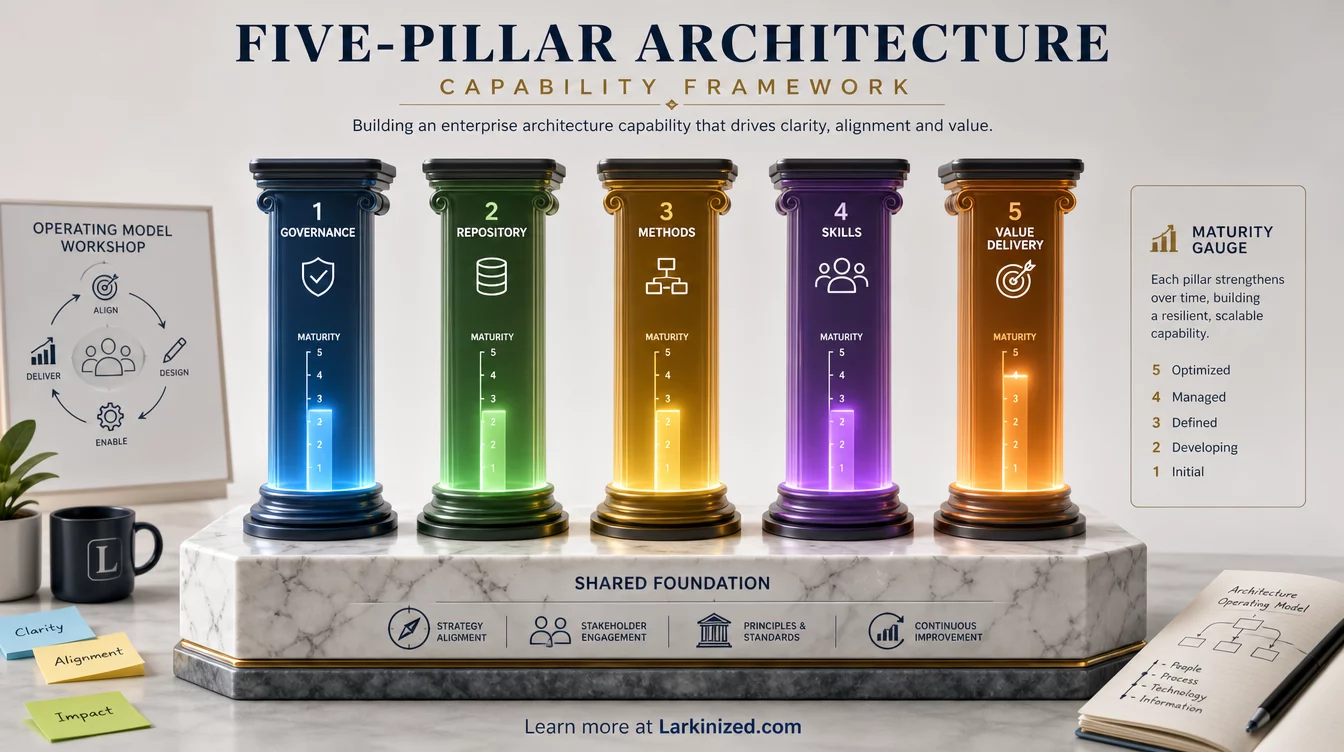
Architecture Capability Framework
People, process, tools, and governance forming a continuous EA capability cycle—assess, plan, deliver, measure—with executive sponsorship and stakeholder feedback.
Key Takeaways
- An architecture capability is an ongoing organizational function—not a one-time documentation project.
- Maturity requires people, process, tools, governance, and culture working together.
- Build capability incrementally with quick wins tied to transformation priorities.
- Measure health through usage, review coverage, alignment metrics, and business outcomes.
- Evolve methods as operating models, cloud, and AI change enterprise needs.
References & Further Reading
- The Open Group, TOGAF Standard — Architecture Capability Framework
- Gartner, EA Capability Maturity Model
- CMMI Institute, Architecture Practices Overview
Need Expert Guidance?
Larkinized LLC helps organizations design, govern, and execute enterprise architecture programs that deliver measurable business outcomes.