
How mature should an Enterprise Architecture practice be?
The right EA maturity level depends on organizational size, complexity, regulatory exposure, and transformation ambition—not on pursuing the highest maturity for its own sake. Effective practices match capability investment to the decisions the enterprise must make well.
Maturity Is Means, Not End
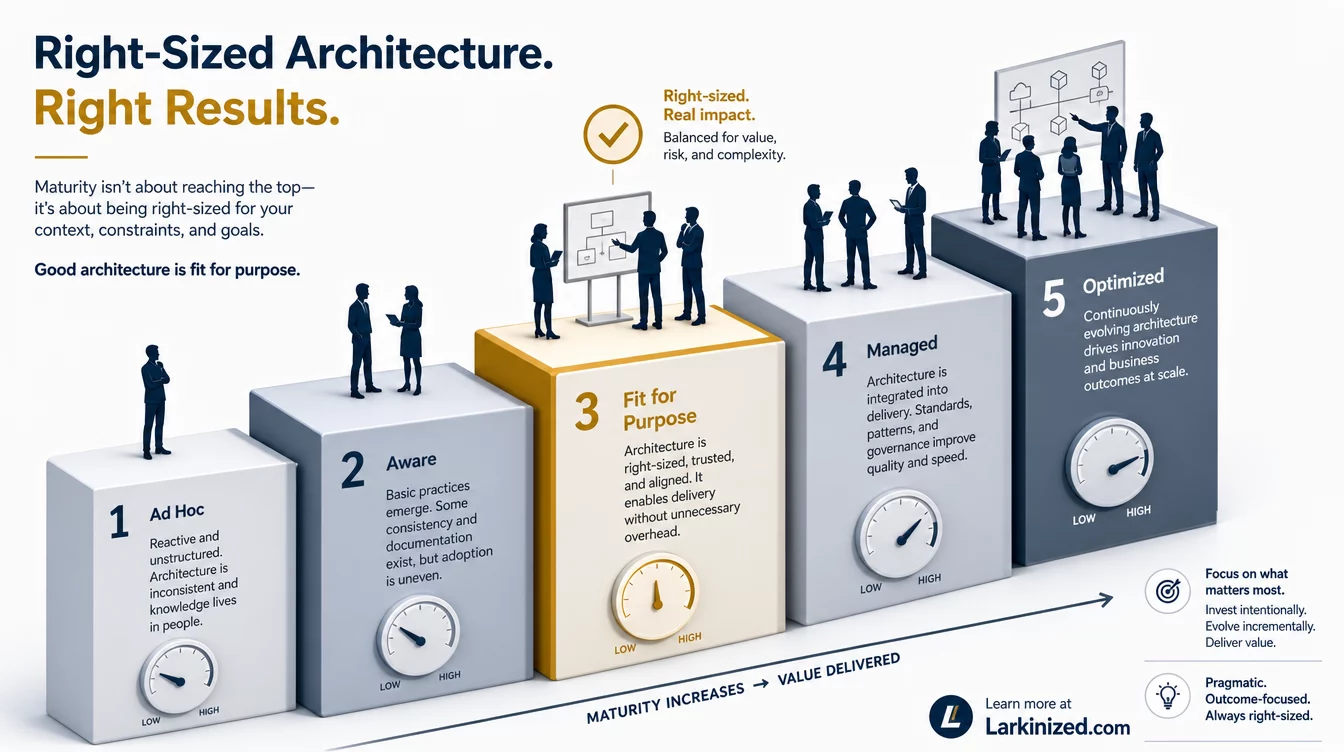
Architecture maturity models describe evolving sophistication—from ad hoc diagrams to optimized, metrics-driven practices integrated with portfolio and agile delivery. Higher maturity is not automatically better. A mid-size firm with stable operations and limited integration needs may function well at level 2 with lightweight governance, while a global bank in multi-year transformation requires level 4 rigor in regulated domains.
Over-maturing EA produces bureaucracy: exhaustive models nobody uses, review boards that delay delivery, certification exercises disconnected from business pain. Under-maturing produces chaos at scale. The goal is fit-for-purpose capability that improves decision quality per dollar spent.
Executives should define decisions EA must improve—portfolio prioritization, M&A integration, cloud exit, regulatory traceability—and invest maturity components that directly support those decisions.
Startup versus enterprise maturity expectations differ dramatically—startups may operate level 2 with lightweight principles until product-market fit stabilizes, then invest as scale demands.
Typical Maturity Stages and Characteristics
Level 1 Ad hoc: fragmented documentation, hero architects, inconsistent standards. Common in fast-growing firms before formal EA. Level 2 Emerging: charter, initial repository, architecture board for major investments, first roadmaps. Level 3 Established: integrated domains, regular portfolio reviews, standards adoption measured, business architecture linked to planning.
Level 4 Advanced: architecture embedded in agile portfolio management, automated discovery feeding repositories, quantitative alignment metrics, federated model with strong center. Level 5 Optimizing: continuous improvement culture, predictive analytics on architecture drift, industry benchmarking, architecture drives innovation experiments.
Most large enterprises realistically target level 3–4 in critical domains while accepting lighter touch elsewhere. Uniform level 4 everywhere is rarely cost-justified.
Public sector mandates sometimes prescribe minimum maturity for grant eligibility—external forcing functions override internal calibration.
Factors That Demand Higher Maturity
Regulatory intensity—financial services, healthcare, critical infrastructure—requires traceability and control documentation that level 1–2 practices cannot sustain. Frequent M&A needs repeatable due diligence and integration playbooks. Multi-cloud and hybrid estates need standards preventing operational fragmentation.
Transformation ambition also raises the bar. Entering new markets with digital-native competitors while running legacy cores demands strong business and application architecture. AI at scale requires mature data architecture and governance.
Geographic dispersion and product complexity multiply coordination costs that EA maturity offsets. A single-location company with one ERP faces different needs than a conglomerate with dozens of partially integrated units.
Board risk committees may require specific maturity evidence for cyber and operational resilience—elevating priority of affected domains independently.
Assessing Current State Honestly
Assessment combines surveys, artifact reviews, stakeholder interviews, and process tracing—do projects actually consult architecture assets? Do exceptions get documented? Is the repository current? Self-assessment often overstates maturity; external review like Larkinized LLC provides calibration.
Domain-specific maturity may differ: strong technology standards with weak business architecture linkage is common. Improvement plans should close critical gaps first—usually governance plus one high-value roadmap—not pursue perfect models in every domain.
Benchmark peers in similar industries for realistic targets. A retailer need not copy a defense contractor’s EA depth unless entering comparable compliance regimes.
Temporary maturity surges during M&A integration can revert post-integration—plan sustainment or accept deliberate step-down with documented risk acceptance.
Roadmap to Appropriate Maturity
Improvement roadmaps sequence people, process, and tools over 18–36 months. Quick wins—application inventory for CFO questions, integration standards reducing incidents—fund longer investments in repository automation and business architecture integration.
Maturity initiatives need executive sponsors who protect EA from being cannibalized for project staffing. Metrics track progress: review coverage, repository usage, rationalization savings, alignment scores.
Reassess annually as strategy shifts. A maturity level adequate pre-cloud may be insufficient for AI governance. EA maturity is a dial, not a destination—calibrate continuously to enterprise needs.
Tooling maturity should lag slightly behind process maturity—automating broken processes scales dysfunction; fix facilitation and governance first.
Calibrating Maturity to Decision Criticality
Larkinized LLC maps decisions to required maturity: if you only need accurate application inventory for renewals, level 2 practices suffice; if you must prove end-to-end control traceability to regulators, level 4 in affected domains is non-optional. This decision-centric calibration avoids overbuilding while closing gaps that actually hurt.
Maturity investment should follow pain ROI. When integration failures cost millions annually, investing in integration standards and review governance pays back quickly—maturity rises where dollars burn fastest. Low-pain domains can lag without jeopardizing enterprise outcomes.
Reassess maturity targets after major events—IPO, acquisition, new CEO strategy, cloud-first mandate—because required decision quality shifts overnight. Maturity is contextual dial, not permanent badge.
Presenting Maturity Recommendations to Leadership
Present maturity recommendations as investment options with costs and decision quality benefits—not maturity scores as vanity metrics.
Use peer benchmarks cautiously—industry averages may not match your regulatory or growth context.
Allow deliberate under-maturity in non-critical domains with written risk acceptance from accountable executive.
Revisit maturity targets after major successful transformation—needs may step down from war footing to steady state.
Practical Guidance from Larkinized LLC
Larkinized LLC calibrates maturity to industry, regulation, and transformation ambition—a regional insurer need not match global bank maturity, but must exceed maturity needed for compliance and growth plans actually approved by the board.
Maturity assessments combine self-evaluation with external benchmarks and evidence reviews—artifact counts without usage signal documentation theater. Assessors ask which board decisions used architecture outputs last quarter.
Deliberate maturity surges during M&A are acceptable if sustainment plans exist post-integration—temporary spikes without funding invite collapse to prior level with worse technical debt than before surge began.
Tooling maturity should trail process maturity slightly—automating broken governance scales dysfunction. Fix facilitation, decision rights, and sponsorship before buying expensive repository platforms teams will not populate.
Public sector grant requirements may mandate minimum maturity—external forcing functions override internal debate. Architecture leaders map grant criteria to capability building plans with explicit owners and dates.
Maturity communicates honestly to executives: under-mature practices promising enterprise-wide governance destroy credibility; over-mature bureaucracy on low-risk portfolios destroys delivery trust. Right-size is continuous negotiation, not one-time assessment score.
Larkinized LLC connects guidance on how mature should an enterprise architecture practice be to named portfolio decisions within the current fiscal year so architecture work is legible in funding systems executives already use. Workshop outputs publish to the repository within two weeks with owners assigned, preventing loss of context when facilitators rotate or consultants depart after initial engagement.
Cross-functional participation includes operations staff who execute daily processes—not only senior leaders whose high-level views omit workarounds that define real performance. Their input grounds models in operational truth and reduces downstream rejection when delivery teams claim architecture ignored how work actually happens.
Education scales beyond central architects through micro-learning for product owners, procurement staff, and engineers, reducing exceptions driven by ignorance rather than genuine strategic conflict. Office hours and internal communities of practice keep guidance current as cloud, agile, and AI practices evolve faster than annual training cycles.
Measurement pairs business KPIs—cycle time, cost per transaction, error rates, regulatory findings—with architecture metrics such as repository usage, review SLA compliance, and portfolio alignment scores. Improvements tied to architecture interventions build executive trust more reliably than model counts alone.
Regulatory and audit stakeholders increasingly expect traceability; viewpoint-specific views linked to repository entities produce evidence in days rather than weeks during examinations. Proactive documentation reduces fire drills, punitive findings, and leadership distraction from core transformation priorities.
M&A, divestiture, and market expansion stress-test architecture assets—scenario playbooks updated annually let leadership pivot with cost and timeline estimates instead of panic discovery after announcements. Capability maps and application inventories become due diligence assets before deals close, not afterthought spreadsheets.
Governance forums for how mature should an enterprise architecture practice be should meet on a predictable cadence tied to portfolio and release planning—not ad hoc when crises force attention. Larkinized LLC recommends standing architecture review slots with published intake criteria, SLA targets, and escalation paths so delivery teams know how to engage without treating architecture as unpredictable gatekeeping that rewards political access over merit of design.
Traceability from strategy statements to capability or architecture elements to funded initiatives to deployed solutions closes the loop executives expect when they approve EA funding. Without traceability, architecture remains a parallel documentation universe. Link charters, requirements, design records, and operational inventories in one searchable repository so auditors, product managers, and engineers retrieve consistent answers instead of conflicting spreadsheets maintained in silos.
Risk management benefits when how mature should an enterprise architecture practice be practices identify concentration risks—single vendor platforms, fragile integrations, key-person dependencies, regions without failover—and map mitigations into migration plans with owners and dates. Risk registers integrated with architecture repositories beat oral tradition during incidents when leadership demands answers within hours and teams cannot afford heroic manual discovery across dozens of systems.
Innovation programs need explicit guardrails within how mature should an enterprise architecture practice be so experiments proceed safely: sandbox environments, data masking rules, time-boxed pilots, and kill criteria before production commitments. Architecture enables innovation velocity by stating what teams may try without enterprise approval versus what requires board-level review because customer data, financial reporting, or safety-critical operations are affected.
Global enterprises localizing how mature should an enterprise architecture practice be should tier standards: mandatory worldwide, recommended regional, optional local—documented in governance charters to prevent both harmful divergence and rejection of valid regional regulatory requirements. Regional architects on a council synchronize proposals before they become de facto standards that conflict with enterprise principles approved by executive sponsors accountable to the board.
Quality assurance for architecture artifacts includes peer review, automated validation where schemas exist, and executive readability checks before publication. Larkinized LLC teaches teams to reject diagrams that look complete but lack definitions, owners, and measures—hallmarks of documentation theater that erodes trust faster than publishing fewer, higher-quality views updated on schedule.
Stakeholder onboarding for how mature should an enterprise architecture practice be never ends; annual refreshers for new leaders, rotating product managers, and engineers hired from acquisitions prevent repeated violations caused by ignorance rather than defiance. Micro-learning, office hours, and annotated examples in repositories scale literacy without requiring week-long courses that busy executives and engineers will not attend consistently.
Ultimately how mature should an enterprise architecture practice be succeeds when leaders reference architecture evidence in routine decisions—funding, hiring, vendor selection, incident response—not only during transformations. Larkinized LLC measures cultural adoption through decision log sampling: what percentage of major investments cited architecture assets in approval packets last quarter? Rising percentages indicate durability; flat or falling percentages signal sponsorship or relevance problems requiring honest retrospective, not additional templates.
EA Maturity Calibration
Organizational complexity and ambition plotted against EA maturity levels—from ad hoc documentation to integrated portfolio-driven architecture—with guidance on proportional investment.
Key Takeaways
- Target EA maturity fit-for-purpose to organizational complexity—not maximum maturity by default.
- Most enterprises aim for established to advanced practices in critical domains while staying lighter elsewhere.
- Regulation, M&A, transformation, and multi-platform estates demand higher maturity investments.
- Honest assessment and domain-specific gap analysis beat generic maturity score chasing.
- Sequence improvement with quick wins and reassess as strategic and technology contexts evolve.
References & Further Reading
- Gartner, Enterprise Architecture Maturity Model
- The Open Group, TOGAF Standard — Architecture Maturity Models
- CMMI Institute, Process Maturity Overview
Need Expert Guidance?
Larkinized LLC helps organizations design, govern, and execute enterprise architecture programs that deliver measurable business outcomes.