
What problems does Enterprise Architecture solve?
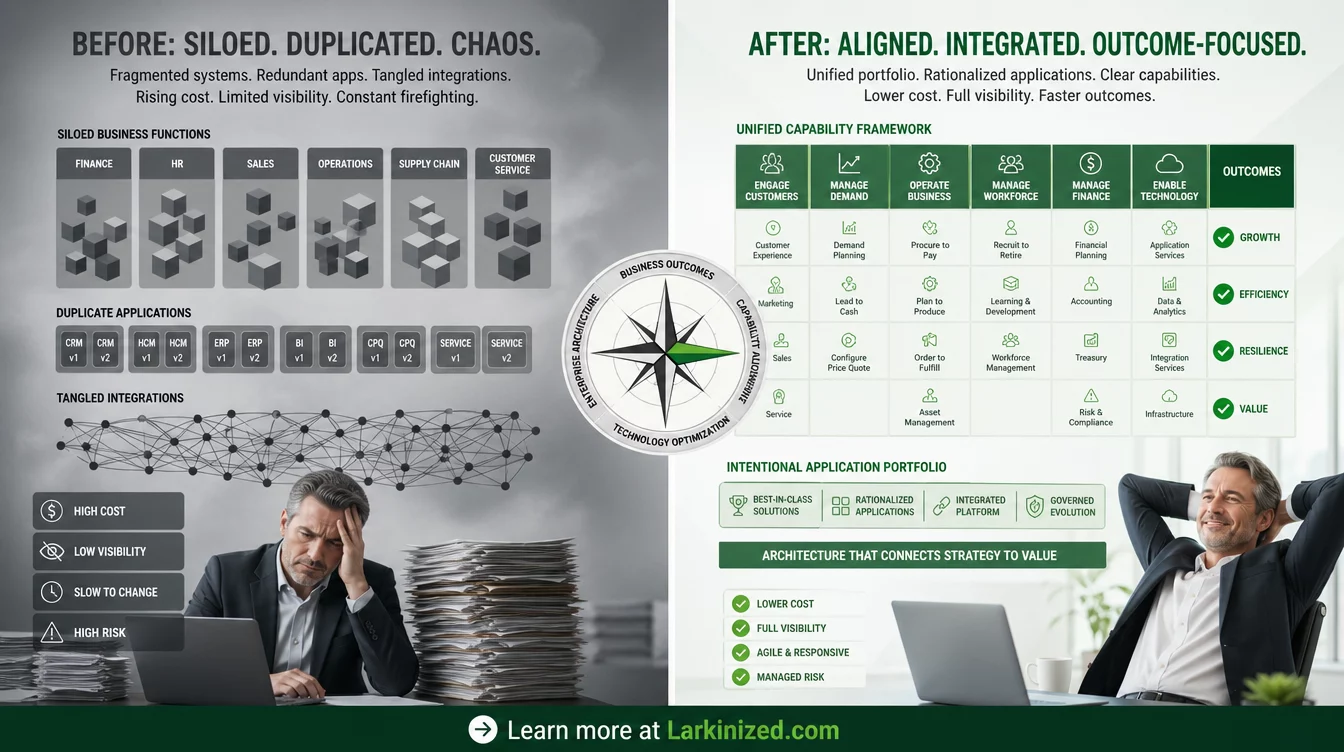
Enterprise Architecture addresses systemic problems that emerge when complex organizations grow faster than their ability to coordinate—redundant systems, opaque dependencies, misaligned investments, and fragile integrations. EA provides structure, visibility, and governance to resolve these challenges sustainably.
Fragmentation and Lack of Enterprise Visibility
Large organizations often cannot answer basic questions: How many customer databases exist? Which systems process payroll in each country? What is the total cost of our CRM landscape? Fragmentation across business units, acquisitions, and shadow IT creates blind spots that inflate risk and cost. EA builds authoritative inventories and models that make the enterprise legible to executives and practitioners.
Without visibility, leaders duplicate investments unknowingly—three divisions buying competing marketing automation tools—or fail to retire sunset systems because ownership is unclear. Architecture repositories and governance processes maintain clarity as change continues.
Visibility also accelerates incident response and audit preparation. When architecture assets document data flows and dependencies, teams isolate failures faster and demonstrate control coverage without emergency archaeology.
Shadow IT proliferation—unsanctioned SaaS—creates data sprawl and security gaps EA inventories and brings under standards or retires with executive support.
Misalignment Between Business and IT
When IT optimizes for uptime while business pursues new digital revenue, mistrust grows. Projects deliver on specifications that no longer match market needs. EA reconnects conversation through shared capability language and traceability from strategy to solutions.
Architecture review surfaces when proposed systems support obsolete processes or ignore enterprise data standards that analytics strategies require. Early correction saves millions compared to rework after launch.
Alignment is continuous, not a workshop once per year. Embedded architects in planning cycles and portfolio boards keep business and IT negotiating from shared facts rather than assumptions.
Vendor sprawl from uncoordinated purchases increases negotiation weakness; EA consolidates demand around preferred platforms improving contract leverage.
Integration Complexity and Technical Debt
Point-to-point integrations multiply until changing one system requires months of regression testing across dozens of interfaces. EA promotes integration patterns—enterprise service bus, API gateways, event hubs—and rationalizes interfaces during modernization.
Technical debt accumulates when shortcuts bypass standards: hard-coded batch files, undocumented APIs, unsupported platforms. Architecture debt registers prioritize remediation linked to business risk—systems touching regulated data, revenue-critical paths.
Cloud migration stalls when architects discover undeclared dependencies and data gravity. EA-led discovery and transition roadmaps de-risk lift-and-shift versus refactor decisions.
Operational reporting inconsistencies—multiple definitions of revenue or customer—stem from data architecture gaps EA resolves through master data and semantic standards.
Portfolio Sprawl and Resource Waste
Application portfolios balloon through acquisitions, departmental purchases, and vendor shelfware. Maintenance consumes budgets needed for innovation. EA-led rationalization categorizes applications by business value and technical health, driving retire-consolidate-replace decisions with executive backing.
Similar sprawl affects infrastructure—duplicate data centers, overlapping monitoring tools, inconsistent identity providers. Technology architecture standards and platform consolidation programs attack waste systematically.
Portfolio analytics tie spend to capabilities, exposing areas where the organization over-invests relative to strategic priority or under-invests in foundations.
Project dependency gridlock—team B waiting on team A indefinitely—surfaces in architecture migration sequencing with explicit critical path ownership.
Transformation Failure and Change Fatigue
Transformation programs fail when scope ignores dependencies, operating model misalignment, or underestimated data work. EA provides sequencing, impact analysis, and stakeholder maps that improve program design before kickoff.
Repeated failed initiatives produce change fatigue. Credible architecture roadmaps with visible early wins rebuild confidence. Communicating how initiatives compose into target states helps employees see purpose beyond yet another reorganization.
Larkinized LLC engages when clients recognize these symptoms—EA is the discipline designed to address them holistically rather than treating each symptom as an isolated project.
Knowledge loss when senior engineers retire is mitigated through architecture repositories documenting rationale beyond tribal memory.
Diagnostic Patterns Larkinized LLC Encounters
Clients often arrive with symptomatic pain—integration project number forty failed—while root causes trace to missing standards, duplicate master data, and portfolio overlap EA addresses systemically. Diagnostics include application pair analysis finding redundant customer records across five systems, integration topology maps exposing spaghettis, and spend analysis showing sixty percent maintenance on retire-candidate apps.
Problem framing for executives converts technical mess into business risk: revenue leakage from inconsistent pricing, compliance exposure from unknown data flows, employee attrition from swivel-chair processes. EA solutions packaged as risk and value stories secure funding better than architecture jargon alone.
Prevention matters as much as remediation. EA embedded early in new product launches prevents greenfield silos that become tomorrow’s legacy. Architecture review for SaaS purchases—before multi-year contracts—blocks shadow IT that EA later must reverse-engineer at higher cost.
From Problem Diagnosis to Remediation Roadmap
Problem diagnosis workshops prioritize top five systemic issues with executive voting—EA roadmap explicitly tracks remediation metrics per problem.
Quick wins tied to each major problem build momentum—do not wait for perfect target state before any relief.
Problem ownership assigned to business and IT pairs—not EA alone—architecture supplies map, owners drive change.
Annual problem registry review asks which chronic issues closed versus relapsed—honest accounting builds credibility.
Practical Guidance from Larkinized LLC
Larkinized LLC diagnoses client pain through evidence—application pair redundancy analysis, integration topology maps, spend on retire-candidate systems—before proposing EA remedies. Executives trust problems stated with numbers more than architecture vocabulary alone.
Shadow IT inventories reveal unsanctioned SaaS spreading customer data—EA brings subscriptions under standards or retires them with sponsor support. Problem framing emphasizes regulatory and revenue risk, not IT control for its own sake.
Vendor sprawl weakens negotiation leverage; EA consolidates demand around preferred platforms with documented exceptions. Procurement partners appreciate architecture-backed spend segmentation during renewal cycles.
Operational reporting conflicts—multiple revenue or customer definitions—stem from data architecture gaps EA resolves through master data and semantic standards tied to authoritative sources and stewardship roles.
Project gridlock when team B waits on team A indefinitely surfaces in migration sequencing with explicit critical path owners—architecture makes dependencies visible portfolio managers can fund and escalate.
Knowledge loss when senior engineers retire mitigates through repositories documenting rationale beyond tribal memory—problems of bus factor become architecture maintenance problems with measurable reduction targets.
Larkinized LLC connects guidance on what problems does enterprise architecture solve to named portfolio decisions within the current fiscal year so architecture work is legible in funding systems executives already use. Workshop outputs publish to the repository within two weeks with owners assigned, preventing loss of context when facilitators rotate or consultants depart after initial engagement.
Cross-functional participation includes operations staff who execute daily processes—not only senior leaders whose high-level views omit workarounds that define real performance. Their input grounds models in operational truth and reduces downstream rejection when delivery teams claim architecture ignored how work actually happens.
Education scales beyond central architects through micro-learning for product owners, procurement staff, and engineers, reducing exceptions driven by ignorance rather than genuine strategic conflict. Office hours and internal communities of practice keep guidance current as cloud, agile, and AI practices evolve faster than annual training cycles.
Measurement pairs business KPIs—cycle time, cost per transaction, error rates, regulatory findings—with architecture metrics such as repository usage, review SLA compliance, and portfolio alignment scores. Improvements tied to architecture interventions build executive trust more reliably than model counts alone.
Regulatory and audit stakeholders increasingly expect traceability; viewpoint-specific views linked to repository entities produce evidence in days rather than weeks during examinations. Proactive documentation reduces fire drills, punitive findings, and leadership distraction from core transformation priorities.
M&A, divestiture, and market expansion stress-test architecture assets—scenario playbooks updated annually let leadership pivot with cost and timeline estimates instead of panic discovery after announcements. Capability maps and application inventories become due diligence assets before deals close, not afterthought spreadsheets.
Governance forums for what problems does enterprise architecture solve should meet on a predictable cadence tied to portfolio and release planning—not ad hoc when crises force attention. Larkinized LLC recommends standing architecture review slots with published intake criteria, SLA targets, and escalation paths so delivery teams know how to engage without treating architecture as unpredictable gatekeeping that rewards political access over merit of design.
Traceability from strategy statements to capability or architecture elements to funded initiatives to deployed solutions closes the loop executives expect when they approve EA funding. Without traceability, architecture remains a parallel documentation universe. Link charters, requirements, design records, and operational inventories in one searchable repository so auditors, product managers, and engineers retrieve consistent answers instead of conflicting spreadsheets maintained in silos.
Risk management benefits when what problems does enterprise architecture solve practices identify concentration risks—single vendor platforms, fragile integrations, key-person dependencies, regions without failover—and map mitigations into migration plans with owners and dates. Risk registers integrated with architecture repositories beat oral tradition during incidents when leadership demands answers within hours and teams cannot afford heroic manual discovery across dozens of systems.
Innovation programs need explicit guardrails within what problems does enterprise architecture solve so experiments proceed safely: sandbox environments, data masking rules, time-boxed pilots, and kill criteria before production commitments. Architecture enables innovation velocity by stating what teams may try without enterprise approval versus what requires board-level review because customer data, financial reporting, or safety-critical operations are affected.
Global enterprises localizing what problems does enterprise architecture solve should tier standards: mandatory worldwide, recommended regional, optional local—documented in governance charters to prevent both harmful divergence and rejection of valid regional regulatory requirements. Regional architects on a council synchronize proposals before they become de facto standards that conflict with enterprise principles approved by executive sponsors accountable to the board.
Quality assurance for architecture artifacts includes peer review, automated validation where schemas exist, and executive readability checks before publication. Larkinized LLC teaches teams to reject diagrams that look complete but lack definitions, owners, and measures—hallmarks of documentation theater that erodes trust faster than publishing fewer, higher-quality views updated on schedule.
Stakeholder onboarding for what problems does enterprise architecture solve never ends; annual refreshers for new leaders, rotating product managers, and engineers hired from acquisitions prevent repeated violations caused by ignorance rather than defiance. Micro-learning, office hours, and annotated examples in repositories scale literacy without requiring week-long courses that busy executives and engineers will not attend consistently.
Ultimately what problems does enterprise architecture solve succeeds when leaders reference architecture evidence in routine decisions—funding, hiring, vendor selection, incident response—not only during transformations. Larkinized LLC measures cultural adoption through decision log sampling: what percentage of major investments cited architecture assets in approval packets last quarter? Rising percentages indicate durability; flat or falling percentages signal sponsorship or relevance problems requiring honest retrospective, not additional templates.
Problems EA Addresses
Fragmentation, redundancy, integration complexity, and misalignment mapped to EA interventions—governance, roadmaps, standards, and portfolio analytics.
Key Takeaways
- EA solves fragmentation by creating authoritative enterprise visibility into systems, data, and dependencies.
- Shared capability models and traceability realign business and IT around common facts and priorities.
- Standards and rationalization reduce integration complexity and managed technical debt.
- Portfolio analytics and governance attack sprawl and misdirected spend.
- Architecture-led sequencing and roadmaps improve transformation success rates and reduce change fatigue.
References & Further Reading
- McKinsey & Company, Technology debt and modernization
- The Open Group, TOGAF Standard — Architecture Governance
- Forrester Research, Application Rationalization Best Practices
Need Expert Guidance?
Larkinized LLC helps organizations design, govern, and execute enterprise architecture programs that deliver measurable business outcomes.