

What are solution building blocks?
Solution Building Blocks (SBBs) are concrete implementations of architecture capability—specific products, custom components, configurations, or deployments that realize one or more Architecture Building Blocks. SBBs represent what actually gets built, bought, or deployed.
From Abstract Capability to Concrete Solution
If Architecture Building Blocks describe what the enterprise needs logically, Solution Building Blocks describe how it is realized physically and operationally. An ABB for enterprise customer notifications might map to SBBs including a specific SaaS campaign tool, an internal SMS gateway service, and a Kubernetes deployment running notification workers.
SBBs carry implementation detail: vendor names, versions, hosting locations, configuration baselines, support ownership. Solution architects and engineers own SBB definitions during project delivery; enterprise architects ensure SBB portfolios collectively satisfy ABB requirements without unacceptable overlap.
Multiple SBBs may implement one ABB during transition—old and new systems in parallel—or one SBB may support multiple ABBs when platforms are shared deliberately.
Environment promotion paths—dev, test, prod—for SBBs should mirror enterprise release standards documented alongside SBB definitions.
SBBs in Implementation and Migration Planning
Phase F migration planning identifies SBBs to add, modify, or retire in each work package. Cutover plans sequence SBB deployments respecting data migration, integration testing, and operational readiness. Phase G governance verifies delivered SBBs match approved architectures and update repositories upon go-live.
Work packages should be sized around deliverable SBB outcomes executives can track—deploy identity provider, migrate billing module—rather than abstract tasks disconnected from architecture.
Transition architectures explicitly document temporary SBB combinations bridging baseline to target—essential for realistic multi-year programs.
Support ownership and SLA tiers for each production SBB avoid ambiguous on-call when incidents strike shared platforms.
Design and Specification Considerations
SBB specifications include interfaces, dependencies, non-functional characteristics, and compliance evidence. They reference standards—encryption algorithms, logging formats—mandated at enterprise level. Security and operations teams review SBB designs for runability before production.
In agile contexts, SBBs may correspond to releasable increments or platform features with definition-of-done including architecture compliance checks. Minimum viable SBBs deliver ABB subsets iteratively when roadmaps allow phased capability.
Configuration management treats SBBs as managed assets with lifecycle states—planned, in development, production, retiring—synced to CMDB or service catalogs where possible.
Security patching cadence per SBB class—COTS versus custom—feeds vulnerability management prioritization linked to architecture inventory.
Portfolio and Rationalization Implications
Application portfolio management catalogs SBBs or groups them into applications for rationalization analysis. Duplicate SBBs implementing the same ABB signal consolidation opportunities. Orphan SBBs without ABB mapping suggest shadow IT or legacy drift.
Cloud migrations often replatform SBBs—lift-and-shift VMs, refactor to managed services, replace with SaaS—while ABB definitions remain stable to measure continuity of business capability.
Larkinized LLC uses ABB-SBB mapping in client inventories to clarify which products can be retired without capability loss versus which retirements require ABB reimplementation.
Cost allocation tags on cloud SBBs enable FinOps chargeback conversations tied to capability funding decisions.
Common Pitfalls
Confusing products with ABBs—calling Salesforce an ABB when it is an SBB—blurs abstraction layers and weakens gap analysis. Conversely, never translating ABBs into SBBs leaves architecture unimplementable.
Undocumented SBB sprawl in multi-cloud environments creates operational nightmares. Architecture governance requires registration of significant new SBBs with linkage to standards and ABB parents.
Strong practice maintains bidirectional traceability: executives think in ABBs and capabilities; delivery teams execute SBBs; repositories connect both for impact analysis.
Decommission runbooks for SBBs include data archival, legal hold checks, and downstream consumer notification steps.
Managing SBB Lifecycle in Enterprise Catalogs
Larkinized LLC integrates SBB records with CMDB or service catalog where possible—manual duplicate maintenance fails. Automated discovery feeds cloud resources into draft SBB candidates architects approve or merge. Drift detection highlights undeclared SBBs operating outside standards.
Transition states deserve explicit modeling: pilot SBB, production SBB, retiring SBB with sunset date, decommissioned with archive link to lessons learned. Migration programs stall when transition inventory is informal spreadsheet lost after reorg.
SBB rationalization workshops score technical health, business fit, and ABB coverage—retire candidates with executive sign-off tied to cost savings and risk reduction metrics published internally.
Operational Excellence for SBB Catalogs
Operational teams validate SBB catalog accuracy quarterly against monitoring discoveries—architects alone cannot keep pace with organic cloud growth.
SBB incident history feeds rationalization decisions—flaky components retired earlier when business allows.
License compliance audits use SBB inventory as source—financial risk reduction justifies maintenance investment.
SBB sunset communications include consumer migration timelines and support contact—architecture owns communication template.
Practical Guidance from Larkinized LLC
Larkinized LLC inventories SBBs with owners, SLAs, environment promotion paths, and decommission runbooks—operations truth must match architecture repository or governance decisions rely on fiction.
Cloud SBB proliferation requires automated discovery—hundreds of small managed services bill monthly without appearing on PowerPoint landscapes until FinOps escalates surprise spend.
Security patching cadence per SBB class feeds vulnerability prioritization—COTS versus custom versus serverless differ; architecture links SBB classes to risk treatment plans.
Cost allocation tags on cloud SBBs enable FinOps conversations tied to capability funding—technology spend visible to business sponsors owning capability outcomes.
SBB incident history informs rationalization—flaky components retire earlier when business continuity allows; architecture supports evidence-based retirement debates emotionally charged otherwise.
Decommission includes data archival, legal hold, and consumer notification—architecture templates ensure technical teardown does not skip compliance steps creating liability after servers disappear.
Joint operations-architecture reviews quarterly reconcile monitoring discoveries with repository SBB records—accuracy matters more than diagram aesthetics for governance credibility.
Larkinized LLC connects guidance on what are solution building blocks to named portfolio decisions within the current fiscal year so architecture work is legible in funding systems executives already use. Workshop outputs publish to the repository within two weeks with owners assigned, preventing loss of context when facilitators rotate or consultants depart after initial engagement.
Cross-functional participation includes operations staff who execute daily processes—not only senior leaders whose high-level views omit workarounds that define real performance. Their input grounds models in operational truth and reduces downstream rejection when delivery teams claim architecture ignored how work actually happens.
Education scales beyond central architects through micro-learning for product owners, procurement staff, and engineers, reducing exceptions driven by ignorance rather than genuine strategic conflict. Office hours and internal communities of practice keep guidance current as cloud, agile, and AI practices evolve faster than annual training cycles.
Measurement pairs business KPIs—cycle time, cost per transaction, error rates, regulatory findings—with architecture metrics such as repository usage, review SLA compliance, and portfolio alignment scores. Improvements tied to architecture interventions build executive trust more reliably than model counts alone.
Regulatory and audit stakeholders increasingly expect traceability; viewpoint-specific views linked to repository entities produce evidence in days rather than weeks during examinations. Proactive documentation reduces fire drills, punitive findings, and leadership distraction from core transformation priorities.
M&A, divestiture, and market expansion stress-test architecture assets—scenario playbooks updated annually let leadership pivot with cost and timeline estimates instead of panic discovery after announcements. Capability maps and application inventories become due diligence assets before deals close, not afterthought spreadsheets.
Governance forums for what are solution building blocks should meet on a predictable cadence tied to portfolio and release planning—not ad hoc when crises force attention. Larkinized LLC recommends standing architecture review slots with published intake criteria, SLA targets, and escalation paths so delivery teams know how to engage without treating architecture as unpredictable gatekeeping that rewards political access over merit of design.
Traceability from strategy statements to capability or architecture elements to funded initiatives to deployed solutions closes the loop executives expect when they approve EA funding. Without traceability, architecture remains a parallel documentation universe. Link charters, requirements, design records, and operational inventories in one searchable repository so auditors, product managers, and engineers retrieve consistent answers instead of conflicting spreadsheets maintained in silos.
Risk management benefits when what are solution building blocks practices identify concentration risks—single vendor platforms, fragile integrations, key-person dependencies, regions without failover—and map mitigations into migration plans with owners and dates. Risk registers integrated with architecture repositories beat oral tradition during incidents when leadership demands answers within hours and teams cannot afford heroic manual discovery across dozens of systems.
Innovation programs need explicit guardrails within what are solution building blocks so experiments proceed safely: sandbox environments, data masking rules, time-boxed pilots, and kill criteria before production commitments. Architecture enables innovation velocity by stating what teams may try without enterprise approval versus what requires board-level review because customer data, financial reporting, or safety-critical operations are affected.
Global enterprises localizing what are solution building blocks should tier standards: mandatory worldwide, recommended regional, optional local—documented in governance charters to prevent both harmful divergence and rejection of valid regional regulatory requirements. Regional architects on a council synchronize proposals before they become de facto standards that conflict with enterprise principles approved by executive sponsors accountable to the board.
Quality assurance for architecture artifacts includes peer review, automated validation where schemas exist, and executive readability checks before publication. Larkinized LLC teaches teams to reject diagrams that look complete but lack definitions, owners, and measures—hallmarks of documentation theater that erodes trust faster than publishing fewer, higher-quality views updated on schedule.
Stakeholder onboarding for what are solution building blocks never ends; annual refreshers for new leaders, rotating product managers, and engineers hired from acquisitions prevent repeated violations caused by ignorance rather than defiance. Micro-learning, office hours, and annotated examples in repositories scale literacy without requiring week-long courses that busy executives and engineers will not attend consistently.
Ultimately what are solution building blocks succeeds when leaders reference architecture evidence in routine decisions—funding, hiring, vendor selection, incident response—not only during transformations. Larkinized LLC measures cultural adoption through decision log sampling: what percentage of major investments cited architecture assets in approval packets last quarter? Rising percentages indicate durability; flat or falling percentages signal sponsorship or relevance problems requiring honest retrospective, not additional templates.
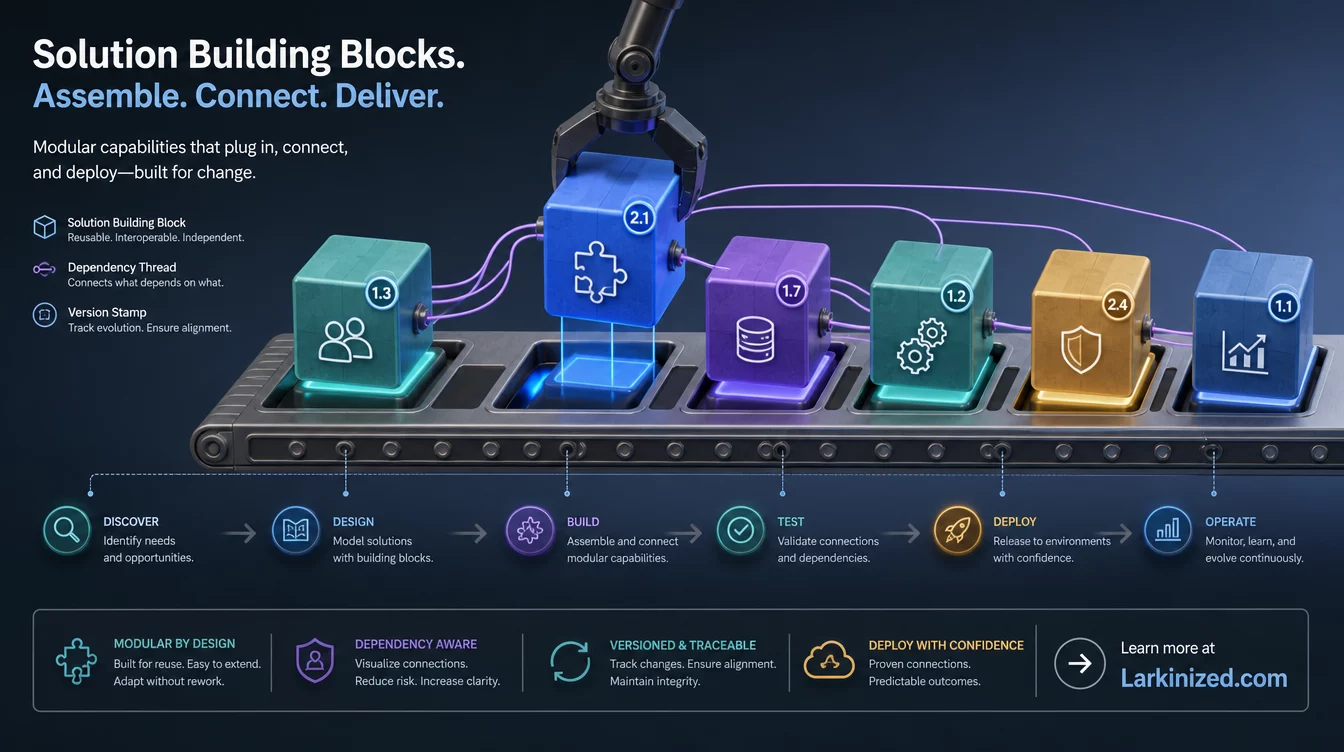
Solution Building Block Deployment
Solution Building Blocks as deployable components—vendor packages, microservices, infrastructure stacks—mapped upward to Architecture Building Blocks and outward to environments and release units.
Key Takeaways
- SBBs are concrete implementations—products, services, deployments—that realize Architecture Building Blocks.
- Migration work packages deliver, modify, or retire SBBs with explicit transition states.
- Specifications cover interfaces, NFRs, compliance, and operational readiness.
- Portfolio mapping exposes duplicate SBBs and orphan systems against enterprise ABBs.
- Maintain clear ABB versus SBB distinction for traceability from strategy to deployment.
References & Further Reading
- The Open Group, TOGAF Standard — Solution Building Blocks
- The Open Group, TOGAF Standard — Implementation and Migration
- IASA Global, Solution Architecture Deliverables
Need Expert Guidance?
Larkinized LLC helps organizations design, govern, and execute enterprise architecture programs that deliver measurable business outcomes.