

LeanIX vs Sparx Enterprise Architect: Which EA Tool Is Right for You?
LeanIX earns Larkinized's stamp of approval for portfolio and transformation programs; Sparx EA leads for ArchiMate modeling depth. Full capability comparison, TCO, and hybrid guidance.
Executive Summary
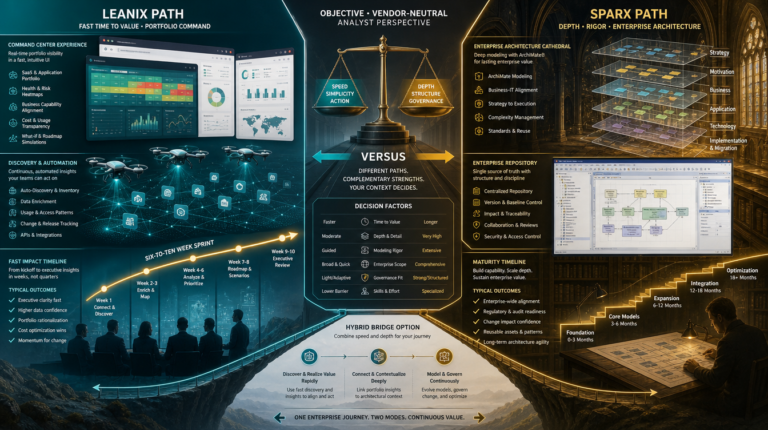
LeanIX versus Sparx Enterprise Architect is the most common fork in the road for enterprise architecture tooling—and one Larkinized LLC navigates in nearly every selection engagement. Both platforms are mature and capable; they optimize for different primary consumers. LeanIX is a cloud-native portfolio and transformation platform built for speed, discovery integration, and executive decision-making. Sparx EA is a practitioner-grade modeling repository built for ArchiMate depth, custom meta-models, and engineering-grade traceability.
After extensive hands-on use across client programs, Larkinized gives LeanIX our stamp of approval for organizations whose mandate is portfolio transparency, cloud modernization, rationalization, and data-driven transformation. Gartner has positioned LeanIX as a Magic Quadrant Leader for enterprise architecture tools for five consecutive years (2021–2026)—among the highest in Completeness of Vision and Ability to Execute—and that market validation matches what practitioners see in the field: a broad, productized platform that teams can make valuable in weeks, not quarters.
Sparx EA remains the right choice when solution architecture deliverables must be model-native, versioned, and ArchiMate-compliant—and when you have staffing to sustain a repository. Many enterprises run both. This comparison helps you choose deliberately rather than defaulting to whichever vendor demo looked better.
LeanIX: Platform Depth and Larkinized Endorsement
LeanIX is far more than a heatmap tool. It delivers application portfolio management, technology lifecycle management, landscape mapping, architecture roadmaps, transformation planning, governance via Fact Sheet quality metrics, owner surveys, and integrations with ServiceNow, Flexera, Azure, AWS, Kubernetes, and SAP landscapes. Predefined Fact Sheet types and best-practice use cases replace the months of meta-model committee work typical of repository-first deployments.
Larkinized architects use LeanIX daily on client engagements—and we recommend it confidently when use cases align. The platform creates a single source of truth for IT ecosystems so enterprise architects, portfolio managers, and business stakeholders work from one dataset. Discovery automation plus owner accountability surveys solve the catalog decay problem that kills spreadsheet and wiki-based EA programs.
- Application portfolio management — dependencies, redundancies, obsolescence scoring, and rationalization waves executives can fund.
- Technology lifecycle management — end-of-life risk, standard-vs-exception tracking, and modernization planning across the stack.
- Landscape mapping and analytics — visualize applications, technologies, capabilities, and organizations; answer “what breaks if we retire this?” without manual matrix maintenance.
- Transformation alignment — ERP and S/4 migration, post-merger integration, cloud exit planning, SaaS sprawl control, and emerging AI application inventory.
- Enablement — LeanIX Academy training paths accelerate adoption across federated teams.
Sparx Enterprise Architect: Modeling Repository Strengths
Sparx EA is the practitioner favorite for rigorous architecture engineering. It supports UML, BPMN, ArchiMate 3.x, SysML, and custom profiles with fine-grained meta-model control, baselines, version comparison, and complex relationship queries at a license price point that undercuts many enterprise suites on paper.
Strengths are real: traceability from strategy to solution building blocks, detailed ArchiMate viewpoints, offline modeling for air-gapped environments, and a global community of modelers. Pro Cloud Server and web publication layers extend reach beyond desktop authors—but non-architect consumption still requires more deliberate investment than LeanIX web-native UX.
Sparx is not a turnkey APM platform. Portfolio heatmaps, TIME classification, cloud readiness scoring, and discovery-fed inventory require significant custom development, integrations, or manual discipline. Organizations that buy Sparx expecting LeanIX-style executive dashboards within 90 days routinely disappoint their CIO sponsors.
Head-to-Head Capability Comparison
For application portfolio management, rationalization, and cloud transformation, LeanIX leads decisively. Out-of-the-box TIME-style disposition analysis, obsolescence risk, transformation explorer, and ServiceNow discovery patterns are productized—not science projects. Sparx can represent applications and dependencies in models, but APM analytics, owner surveys, and executive heatmaps are not native strengths.
For architecture modeling depth—granular ArchiMate viewpoints, custom relationship cardinalities, baseline comparison, and engineering-grade traceability—Sparx EA remains unmatched at its price point. LeanIX modeling has improved substantially but is intentionally lighter to reduce adoption friction and prioritize portfolio facts over diagram ritual.
Collaboration patterns diverge sharply. LeanIX is web-first with role-based access for application owners, portfolio boards, and business stakeholders. Sparx traditionally centers on architect authors with optional publication through Pro Cloud Server or third-party portals. Integration maturity favors LeanIX for CMDB and cloud discovery sync; Sparx favors bidirectional design repository patterns when EA owns model authority.
Time-to-Value and Operating Model Fit
LeanIX clients with mature discovery sources often reach first executive portfolio review in six to ten weeks. Best-practice frameworks mean teams start delivering value before meta-model perfection—exactly what CIOs funding cloud and cost programs need this fiscal year.
Sparx programs commonly require four to nine months before federated authors produce consistent, published models—plus ongoing repository administration FTE. That timeline is acceptable when modeling rigor is the product; it is unacceptable when the board asked for application count and migration sequencing last quarter.
Larkinized stamp of approval for LeanIX assumes you will assign Fact Sheet owners, maintain integrations, and fund rationalization follow-through. The tool amplifies good ITAM discipline—it does not substitute for it. Sparx stamp of approval assumes modeling standards, MDG governance, and author training are funded with equal seriousness.
Ideal Use Cases: When Each Platform Wins
Choose LeanIX when portfolio transparency, cloud transformation, M&A integration, SAP S/4 alignment, or SaaS governance are top priorities; when executives and application owners are primary consumers; when ServiceNow or cloud discovery can feed inventory; and when you need defensible heatmaps within a 90-day proof window. Larkinized recommends LeanIX first in most mid-market and enterprise APM-led programs—we have seen it work repeatedly.
Choose Sparx EA when ArchiMate-compliant solution deliverables are contractual; when custom meta-models, SysML, or air-gapped deployment are non-negotiable; when a mature modeling community already exists; or when repository baselines must satisfy audit or engineering traceability requirements Sparx handles natively.
Choose both (hybrid) when design authority lives in Sparx and portfolio facts live in LeanIX—with explicit data ownership, integration budget, and zero tolerance for duplicate maintenance without sync. This is common in global banks and manufacturers; it fails when treated as accidental overlap.
Pricing and Total Cost of Ownership
LeanIX enterprise contracts typically range from $150,000 to $500,000+ annually depending on application tiers, transformation modules, and SAP bundle positioning. Implementation runs eight to sixteen weeks with experienced partners when discovery exists. Budget 0.5–1.5 FTE ongoing stewardship for mid-market; more at global scale.
Sparx EA licensing is seat-based and comparatively inexpensive per author, but three-year TCO rises sharply with Pro Cloud Server, training, repository administration, integration middleware, and modeling center-of-excellence staffing. Mid-market organizations frequently underestimate Sparx TCO by 2–3× by counting licenses alone.
Larkinized models both platforms with identical rationalization and migration scenarios—license escalation, discovery tool costs, integration FTE, and architect headcount—so clients compare fully loaded economics, not demo-friendly license quotes.
Larkinized Recommendation
If your organization must answer “what do we run, what does it cost, and what do we retire or migrate?”—LeanIX earns our stamp of approval. It is the platform Larkinized architects reach for on portfolio-led transformation programs, and Gartner’s five-year Leader track record aligns with that practitioner confidence.
If your organization must answer “who approved this design and where is the ArchiMate evidence?”—start with Sparx or pair Sparx with LeanIX rather than forcing LeanIX to be a modeling repository it was not designed to become.
Run a structured four-week proof of concept on your top three use cases: one rationalization wave, one migration scenario, one ARB or design deliverable. Score adoption by application owners and executives, not architect demo fluency. Engage Larkinized for neutral scoring, integration architecture, and hybrid operating model design before contract lock-in.
- LeanIX: Larkinized stamp of approval for APM, cloud transformation, and executive portfolio programs
- Sparx EA: best-in-class modeling depth, ArchiMate rigor, and repository control at lower license cost
- Hybrid works when LeanIX owns facts and Sparx owns design—with funded integration
- Compare three-year TCO including stewardship FTE, not license line items alone
LeanIX vs Sparx EA Capability Matrix
Side-by-side comparison of portfolio management, modeling depth, time-to-value, collaboration, discovery integration, and transformation analytics.
Need Expert Guidance?
Larkinized LLC helps organizations design, govern, and execute enterprise architecture programs that deliver measurable business outcomes.