
How long does it take to complete an ADM cycle?
A full enterprise-wide TOGAF ADM cycle typically spans months to years depending on scope, maturity, and organizational complexity—while focused ADM iterations for segments or programs may complete in weeks to a few months. Duration is driven by decision needs, not arbitrary phase calendars.
No Single Answer: Scope Defines Duration
Asking how long an ADM cycle takes is like asking how long a planning cycle takes—it depends on boundary. A first-pass enterprise architecture for a global conglomerate with undocumented legacy estates may require twelve to thirty-six months to establish credible baselines, targets, and migration plans across divisions. A focused ADM iteration for one business capability—modernizing order management—might complete in eight to sixteen weeks with dedicated facilitation.
TOGAF designs ADM as repeatable at multiple levels of the Enterprise Continuum. Organizations run overlapping cycles: a long horizon enterprise roadmap refreshes annually while quarterly segment iterations adjust for market shifts and project-level cycles govern major releases.
Duration should be negotiated with executives based on decisions needed by specific dates—board funding, regulatory filing, product launch—not on completing every template in the content framework.
Benchmarking internal cycle times against prior years shows maturity progress—second enterprise pass should be faster than first if repository reuse works.
Phase-Level Time Expectations
Preliminary Phase for new EA programs often takes one to three months to establish governance, principles, and tooling. Phase A Architecture Vision workshops typically span two to six weeks for a major initiative. Phases B through D depth varies widely: a rapid capability assessment might take four weeks; comprehensive domain architecture for a regulated unit might take three to six months.
Phase E and F migration planning often aligns with annual or semi-annual portfolio planning—four to eight weeks of intensive sequencing once domain gaps are known. Phase G lasts the duration of implementing projects—months to years—with continuous lightweight governance. Phase H triggers when significant change occurs, sometimes quarterly reviews rather than one epic cycle end.
Attempting Phases B through F for the entire enterprise in one monolithic block frequently fails. Iterative domain and segment passes deliver value sooner.
Holiday and fiscal calendars affect realistic scheduling—avoid architecture vision workshops during year-end close when finance unavailable.
Factors That Accelerate or Delay Cycles
Accelerators include executive sponsorship, existing inventories, skilled facilitators, and clear strategic mandate. Delays stem from stakeholder unavailability, political disputes over target states, underestimated data quality work, and analysis paralysis chasing perfect models.
Tooling and prior repository content shorten baselines. Greenfield firms move faster than post-merger integrations requiring duplicate capability reconciliation. Regulatory scrutiny adds time but reduces downstream rework.
Agile organizations time-box architecture iterations to match PI or quarterly planning cadences—architecture sprints producing decision-grade outputs, not encyclopedias.
Critical path for ADM often waits on business SME availability not architect modeling speed—schedule SMEs early with executive mandate.
Aligning ADM Duration with Portfolio Cadence
Effective programs map ADM iterations to portfolio gates. If major funding decisions occur each June, Phase E through F outputs must be ready weeks earlier with executive-readable summaries. Continuous delivery environments integrate Phase G into release trains with rolling architecture review rather than annual big bang.
Parallel cycles prevent bottlenecks: enterprise architects maintain directional roadmaps while embedded architects run fast ADM passes for product lines. Synchronization forums resolve conflicts between segment targets and enterprise standards.
Larkinized LLC coaches clients to publish architecture calendars showing when baselines refresh, when roadmaps update, and which decisions each cycle supports—setting realistic expectations across stakeholders.
Partial cycle completion is valid deliverable when decision made—document deferral rationale rather than delaying decision for completeness theater.
Measuring Progress Without Waiting for Full Cycle Completion
Value milestones beat calendar completion: inventory available for CFO, integration standards reducing incidents, migration wave one funded. Each milestone corresponds to ADM outputs without requiring full enterprise cycle closure.
Architecture maturity grows over multiple cycles. First cycle may achieve Phase A through F for one segment; second cycle expands coverage and refines migration plans based on implementation feedback from Phase G.
Executives should ask when decisions improve, not when the cycle diagram completes. Right-sized ADM iterations respect that architecture serves the business clock, not the reverse.
Post-cycle archiving preserves snapshots for audit—what we believed at funding time—supporting later variance analysis without blame games.
Planning Architecture Calendars with Executives
Larkinized LLC co-authors architecture calendars with PMO and finance showing when roadmaps must be ready for capital committees, when baselines refresh for risk reporting, and when segment ADM iterations align to product PI planning. Shared calendars reduce surprise requests for comprehensive architecture overnight before board meetings.
Resource planning should staff ADM iterations realistically—facilitators, domain SMEs, repository analysts—not assume architects alone produce outputs nights and weekends. Under-resourced cycles slip and blame falls on TOGAF rather than staffing truth.
Parallel ADM tracks require synchronization points—enterprise standards updates may block segment migration plans until published. Schedule explicit merge weeks quarterly so parallel work converges before funding locks.
Negotiating Realistic Timelines with Executives
Present timeline options as scenarios—fast segment pass versus comprehensive enterprise pass—with cost and decision quality trade-offs explicit.
Never commit to enterprise-wide ADM completion dates without baseline inventory maturity assessment—unknown unknowns dominate first cycles.
Build buffer for stakeholder scheduling realities—executive calendars fill months ahead.
Celebrate on-time delivery of decision milestones even when full cycle continues—morale matters in multi-year programs.
Practical Guidance from Larkinized LLC
Larkinized LLC publishes architecture calendars aligning ADM iterations to portfolio gates—if June funding decisions matter, Phase E through F outputs ready weeks earlier with executive summaries, not raw models.
First enterprise pass may take twelve to thirty-six months; focused capability iteration may take eight to sixteen weeks—never sell one timeline for both scopes in the same steering committee meeting.
Critical path often waits on business SME availability, not architect modeling speed—schedule SMEs with executive mandate before workshop invitations go out.
Partial cycle completion is valid when decisions made—document deferred work rather than delaying funding for completeness theater that adds no decision quality.
Benchmark internal cycle duration year over year—second pass should accelerate if repository reuse works; stagnation signals repository neglect or excessive re-baselining from weak Phase H.
Holiday and fiscal calendars affect realism—avoid architecture vision workshops during year-end close when finance cannot validate investment cases tied to migration plans.
Larkinized LLC connects guidance on how long does it take to complete an adm cycle to named portfolio decisions within the current fiscal year so architecture work is legible in funding systems executives already use. Workshop outputs publish to the repository within two weeks with owners assigned, preventing loss of context when facilitators rotate or consultants depart after initial engagement.
Cross-functional participation includes operations staff who execute daily processes—not only senior leaders whose high-level views omit workarounds that define real performance. Their input grounds models in operational truth and reduces downstream rejection when delivery teams claim architecture ignored how work actually happens.
Education scales beyond central architects through micro-learning for product owners, procurement staff, and engineers, reducing exceptions driven by ignorance rather than genuine strategic conflict. Office hours and internal communities of practice keep guidance current as cloud, agile, and AI practices evolve faster than annual training cycles.
Measurement pairs business KPIs—cycle time, cost per transaction, error rates, regulatory findings—with architecture metrics such as repository usage, review SLA compliance, and portfolio alignment scores. Improvements tied to architecture interventions build executive trust more reliably than model counts alone.
Regulatory and audit stakeholders increasingly expect traceability; viewpoint-specific views linked to repository entities produce evidence in days rather than weeks during examinations. Proactive documentation reduces fire drills, punitive findings, and leadership distraction from core transformation priorities.
M&A, divestiture, and market expansion stress-test architecture assets—scenario playbooks updated annually let leadership pivot with cost and timeline estimates instead of panic discovery after announcements. Capability maps and application inventories become due diligence assets before deals close, not afterthought spreadsheets.
Governance forums for how long does it take to complete an adm cycle should meet on a predictable cadence tied to portfolio and release planning—not ad hoc when crises force attention. Larkinized LLC recommends standing architecture review slots with published intake criteria, SLA targets, and escalation paths so delivery teams know how to engage without treating architecture as unpredictable gatekeeping that rewards political access over merit of design.
Traceability from strategy statements to capability or architecture elements to funded initiatives to deployed solutions closes the loop executives expect when they approve EA funding. Without traceability, architecture remains a parallel documentation universe. Link charters, requirements, design records, and operational inventories in one searchable repository so auditors, product managers, and engineers retrieve consistent answers instead of conflicting spreadsheets maintained in silos.
Risk management benefits when how long does it take to complete an adm cycle practices identify concentration risks—single vendor platforms, fragile integrations, key-person dependencies, regions without failover—and map mitigations into migration plans with owners and dates. Risk registers integrated with architecture repositories beat oral tradition during incidents when leadership demands answers within hours and teams cannot afford heroic manual discovery across dozens of systems.
Innovation programs need explicit guardrails within how long does it take to complete an adm cycle so experiments proceed safely: sandbox environments, data masking rules, time-boxed pilots, and kill criteria before production commitments. Architecture enables innovation velocity by stating what teams may try without enterprise approval versus what requires board-level review because customer data, financial reporting, or safety-critical operations are affected.
Global enterprises localizing how long does it take to complete an adm cycle should tier standards: mandatory worldwide, recommended regional, optional local—documented in governance charters to prevent both harmful divergence and rejection of valid regional regulatory requirements. Regional architects on a council synchronize proposals before they become de facto standards that conflict with enterprise principles approved by executive sponsors accountable to the board.
Quality assurance for architecture artifacts includes peer review, automated validation where schemas exist, and executive readability checks before publication. Larkinized LLC teaches teams to reject diagrams that look complete but lack definitions, owners, and measures—hallmarks of documentation theater that erodes trust faster than publishing fewer, higher-quality views updated on schedule.
Stakeholder onboarding for how long does it take to complete an adm cycle never ends; annual refreshers for new leaders, rotating product managers, and engineers hired from acquisitions prevent repeated violations caused by ignorance rather than defiance. Micro-learning, office hours, and annotated examples in repositories scale literacy without requiring week-long courses that busy executives and engineers will not attend consistently.
Ultimately how long does it take to complete an adm cycle succeeds when leaders reference architecture evidence in routine decisions—funding, hiring, vendor selection, incident response—not only during transformations. Larkinized LLC measures cultural adoption through decision log sampling: what percentage of major investments cited architecture assets in approval packets last quarter? Rising percentages indicate durability; flat or falling percentages signal sponsorship or relevance problems requiring honest retrospective, not additional templates.
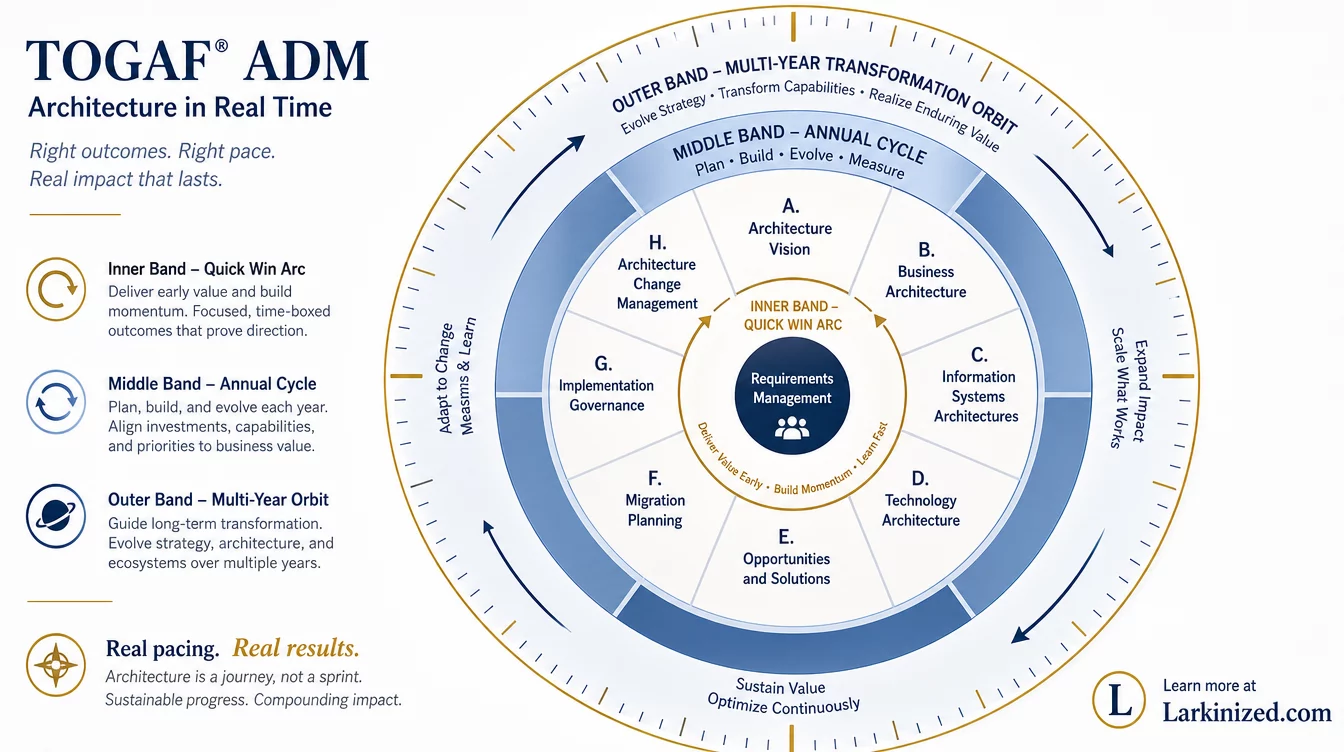
ADM Timeline Horizons
Nested ADM cycles showing enterprise-wide strategic passes (12–36 months), segment iterations (3–9 months), and project-level architecture sprints (2–8 weeks) aligned to portfolio cadence.
Key Takeaways
- ADM cycle duration ranges from weeks for focused iterations to years for full enterprise first passes.
- Phase timelines vary—vision weeks, domain architecture months, governance ongoing.
- Sponsorship, existing assets, and time-boxing accelerate; politics and analysis paralysis delay.
- Align ADM iterations with portfolio funding and agile planning cadences.
- Deliver value through decision milestones rather than waiting for monolithic cycle completion.
References & Further Reading
- The Open Group, TOGAF Standard — Scoping the ADM
- Gartner, EA Roadmap Planning Timelines
- Forrester Research, Agile Architecture Planning Horizons
Need Expert Guidance?
Larkinized LLC helps organizations design, govern, and execute enterprise architecture programs that deliver measurable business outcomes.