
How is TOGAF used in agile organizations?
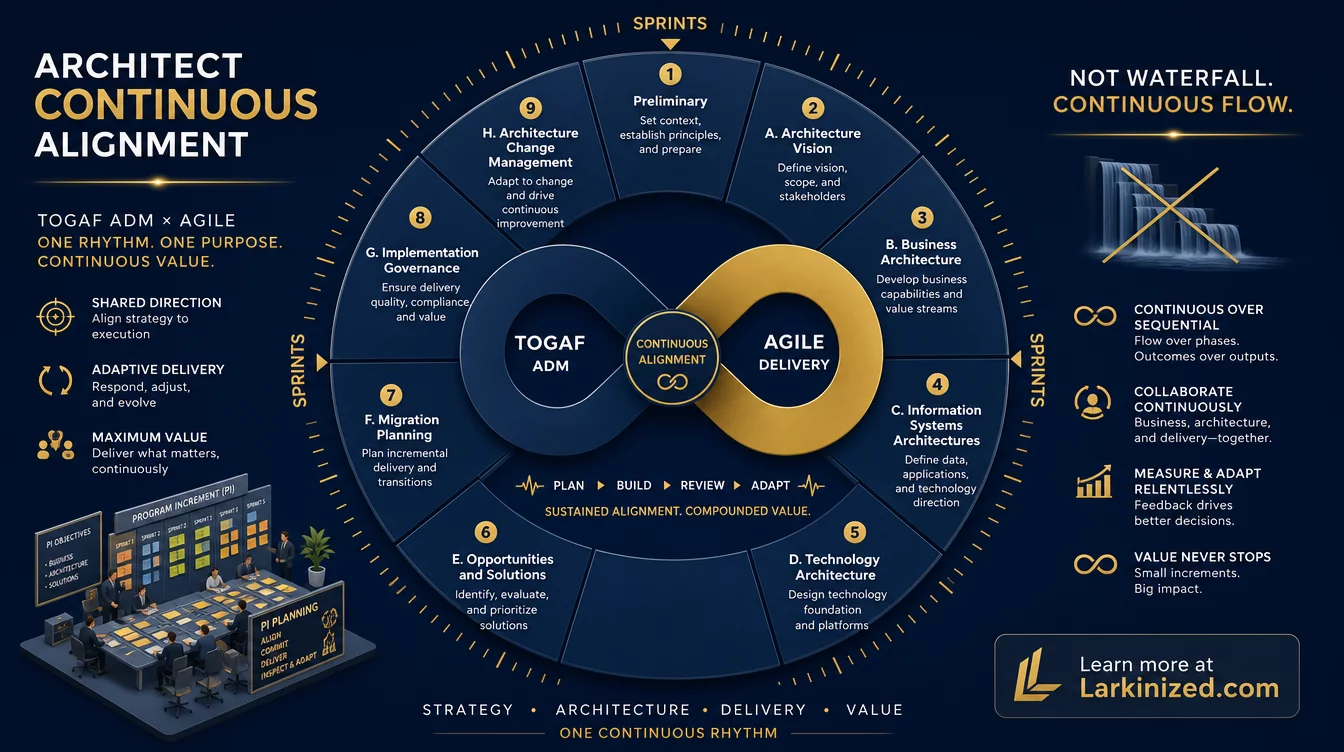
TOGAF adapts to agile organizations through tailored ADM iterations, rolling architecture horizons, embedded architects in product teams, and lightweight governance aligned to release cadences. Architecture becomes a continuous partner to delivery rather than a upfront gate.
Rethinking ADM for Iterative Delivery
Agile organizations reject multi-year documentation phases but still need coherence. TOGAF’s ADM becomes a set of recurring activities rather than a single waterfall pass. Phase A vision may refresh each quarter; Phases B through D run as time-boxed architecture sprints when new capabilities enter roadmaps; Phases G and H integrate into every release retrospective and portfolio sync.
Tailoring documentation in TOGAF explicitly supports this—produce decision-grade artifacts just-in-time for planning events, not comprehensive models before funding exists. Architecture debt registers track shortcuts exactly like technical debt in backlogs.
Requirements Management at ADM center aligns with product backlogs and epic definitions, ensuring architecture concerns appear as enablers and non-functional requirements rather than separate ivory-tower documents.
Spikes and time-boxed research stories map to ADM exploration for uncertain domains—architecture spikes produce decision records feeding backlog refinement.
Architecture Runway and Platform Thinking
Agile frameworks describe architecture runway—foundational work enabling upcoming features. Enterprise architects prioritize runway items: identity integration, API standards, data platform readiness. These map to TOGAF technology and application target elements delivered by platform teams in sprints.
Internal developer platforms express TOGAF standards as self-service templates—golden paths—so feature teams move fast compliantly. Architecture review shifts from document approval to platform metric monitoring and exception handling.
Larkinized LLC aligns runway backlogs with ADM gap analysis so executives see why enabler epics deserve capacity alongside customer features.
Technical debt registers in agile tools link to architecture standards violations—making enterprise debt visible in sprint planning.
Governance in Agile Contexts
Replace heavyweight stage gates with tiered governance: automated policy checks in CI/CD pipelines, office hours for architects, deep review only for high-risk changes crossing enterprise boundaries. TOGAF Phase G becomes continuous compliance verification embedded in Definition of Done.
Architecture boards meet on portfolio cadence—matching PI planning or quarterly business reviews—approving standards changes and resolving cross-team conflicts rather than reviewing every story.
Transparent architecture principles and decision records (ADRs) scale better than centralized sign-off on each microservice.
Release trains may include architecture enabler releases separate from feature releases—communicating platform work value explicitly.
Organizing Architects in Agile Enterprises
Hybrid models prevail: a central EA team maintains vision, standards, and repository; embedded architects join product teams or tribes for daily design decisions. Chapter meetings synchronize embedded architects with enterprise direction—TOGAF preliminary capability structures adapted federated.
Solution and technical architects participate in sprint ceremonies when integration or NFR risks arise. Time allocation balances delivery support with enterprise maintenance—typically sixty percent embedded, forty percent horizontal for many organizations.
Metrics shift to flow: time to compliant deployment, percentage of services using approved patterns, reduction in architecture exceptions—rather than pages modeled.
Product managers receive architecture literacy so they prioritize enabler capacity without viewing it as pure overhead.
SAFe, Scrum, and TOGAF Together
SAFe explicitly positions enterprise architects in portfolio and large solution layers with architecture epics feeding program backlogs—conceptually aligned with TOGAF Phases E and F. Scrum teams consume standards via platform services; TOGAF content lives in wikis and tools linked from backlogs.
Conflicts arise when SAFe ceremonies feel bureaucratic—mitigate by minimizing mandatory artifacts and focusing on decisions SAFe and TOGAF both require: vision, roadmap, compliance, feedback.
Success stories show TOGAF language helping distributed teams coordinate without mandating identical processes—shared ADM phase vocabulary in PI planning alone improves clarity.
Conflict resolution between product autonomy and enterprise standards uses tiered decision matrix published and revisited quarterly.
Concrete Agile EA Ceremonies
Larkinized LLC maps TOGAF activities to SAFe or Scrum events: architecture vision summary presented at PI planning; enabler epics in program backlog; definition of done includes standards compliance checks; inspect and adapt reviews update principles or patterns when recurring exceptions indicate bad rules.
Architecture community of practice meets biweekly for office hours—teams bring design questions, architects update ADRs collectively. This scales better than mandatory review tickets for every pull request while preserving escalation path for high-risk changes.
Documentation lives minimum viable—wikis, ADRs, repository links embedded in Jira or Azure DevOps work items. ADM deliverables become living URLs not frozen PDFs nobody updates after baseline.
Metrics for Agile EA Success
Track percent of services deployed via golden paths, exception resolution time, enabler story completion rate, and architect embedded team satisfaction scores.
Compare delivery velocity before and after platform standards adoption—velocity should rise as runway matures.
Qualitative feedback from product managers on architecture responsiveness quarterly—prevents silent disengagement.
Adjust agile-EA integration yearly based on metrics—not set-and-forget after initial rollout.
Practical Guidance from Larkinized LLC
Larkinized LLC maps ADM phases to PI objectives—architecture enabler stories visible on roadmaps with acceptance criteria referencing standards and ABB updates, not vague enablement labels.
Tiered governance aligns review depth to risk—low-risk features ship fast; high-risk changes get architecture review within days, not months. Proportional governance preserves agile credibility.
Technical debt registers in agile tools link violations to standards—sprint planning allocates remediation capacity alongside features so debt does not grow infinitely.
Product managers receive architecture literacy micro-modules so they prioritize enabler capacity understanding platform runway limits—reduces antagonism between velocity and resilience.
Release trains may include architecture enabler releases communicating platform value explicitly—stakeholders see why quarter lacked customer features but reduced incident rates.
Conflict resolution matrix published quarterly clarifies product autonomy versus enterprise standards—prevents renegotiating same API policy every PI planning.
Larkinized LLC connects guidance on how is togaf used in agile organizations to named portfolio decisions within the current fiscal year so architecture work is legible in funding systems executives already use. Workshop outputs publish to the repository within two weeks with owners assigned, preventing loss of context when facilitators rotate or consultants depart after initial engagement.
Cross-functional participation includes operations staff who execute daily processes—not only senior leaders whose high-level views omit workarounds that define real performance. Their input grounds models in operational truth and reduces downstream rejection when delivery teams claim architecture ignored how work actually happens.
Education scales beyond central architects through micro-learning for product owners, procurement staff, and engineers, reducing exceptions driven by ignorance rather than genuine strategic conflict. Office hours and internal communities of practice keep guidance current as cloud, agile, and AI practices evolve faster than annual training cycles.
Measurement pairs business KPIs—cycle time, cost per transaction, error rates, regulatory findings—with architecture metrics such as repository usage, review SLA compliance, and portfolio alignment scores. Improvements tied to architecture interventions build executive trust more reliably than model counts alone.
Regulatory and audit stakeholders increasingly expect traceability; viewpoint-specific views linked to repository entities produce evidence in days rather than weeks during examinations. Proactive documentation reduces fire drills, punitive findings, and leadership distraction from core transformation priorities.
M&A, divestiture, and market expansion stress-test architecture assets—scenario playbooks updated annually let leadership pivot with cost and timeline estimates instead of panic discovery after announcements. Capability maps and application inventories become due diligence assets before deals close, not afterthought spreadsheets.
Governance forums for how is togaf used in agile organizations should meet on a predictable cadence tied to portfolio and release planning—not ad hoc when crises force attention. Larkinized LLC recommends standing architecture review slots with published intake criteria, SLA targets, and escalation paths so delivery teams know how to engage without treating architecture as unpredictable gatekeeping that rewards political access over merit of design.
Traceability from strategy statements to capability or architecture elements to funded initiatives to deployed solutions closes the loop executives expect when they approve EA funding. Without traceability, architecture remains a parallel documentation universe. Link charters, requirements, design records, and operational inventories in one searchable repository so auditors, product managers, and engineers retrieve consistent answers instead of conflicting spreadsheets maintained in silos.
Risk management benefits when how is togaf used in agile organizations practices identify concentration risks—single vendor platforms, fragile integrations, key-person dependencies, regions without failover—and map mitigations into migration plans with owners and dates. Risk registers integrated with architecture repositories beat oral tradition during incidents when leadership demands answers within hours and teams cannot afford heroic manual discovery across dozens of systems.
Innovation programs need explicit guardrails within how is togaf used in agile organizations so experiments proceed safely: sandbox environments, data masking rules, time-boxed pilots, and kill criteria before production commitments. Architecture enables innovation velocity by stating what teams may try without enterprise approval versus what requires board-level review because customer data, financial reporting, or safety-critical operations are affected.
Global enterprises localizing how is togaf used in agile organizations should tier standards: mandatory worldwide, recommended regional, optional local—documented in governance charters to prevent both harmful divergence and rejection of valid regional regulatory requirements. Regional architects on a council synchronize proposals before they become de facto standards that conflict with enterprise principles approved by executive sponsors accountable to the board.
Quality assurance for architecture artifacts includes peer review, automated validation where schemas exist, and executive readability checks before publication. Larkinized LLC teaches teams to reject diagrams that look complete but lack definitions, owners, and measures—hallmarks of documentation theater that erodes trust faster than publishing fewer, higher-quality views updated on schedule.
Stakeholder onboarding for how is togaf used in agile organizations never ends; annual refreshers for new leaders, rotating product managers, and engineers hired from acquisitions prevent repeated violations caused by ignorance rather than defiance. Micro-learning, office hours, and annotated examples in repositories scale literacy without requiring week-long courses that busy executives and engineers will not attend consistently.
Ultimately how is togaf used in agile organizations succeeds when leaders reference architecture evidence in routine decisions—funding, hiring, vendor selection, incident response—not only during transformations. Larkinized LLC measures cultural adoption through decision log sampling: what percentage of major investments cited architecture assets in approval packets last quarter? Rising percentages indicate durability; flat or falling percentages signal sponsorship or relevance problems requiring honest retrospective, not additional templates.
Agile EA Rhythm
Rolling architecture vision with quarterly capability increments, architecture runway sprints, embedded review in PI planning, and continuous repository updates synchronized to release trains.
Key Takeaways
- Run ADM as recurring, time-boxed activities aligned to agile planning—not one waterfall pass.
- Invest in architecture runway and platforms that encode TOGAF standards as self-service paths.
- Use tiered governance: automation and ADRs for most decisions; deep review for high-risk changes.
- Organize federated architects embedded in teams with enterprise coordination forums.
- Integrate TOGAF with SAFe or Scrum via shared vision, roadmap, and compliance feedback loops.
References & Further Reading
- The Open Group, TOGAF Standard — Agile Architecture
- Scaled Agile, Inc., SAFe — Enterprise Architecture
- Gartner, Agile EA Operating Models
Need Expert Guidance?
Larkinized LLC helps organizations design, govern, and execute enterprise architecture programs that deliver measurable business outcomes.