
ArchiMate
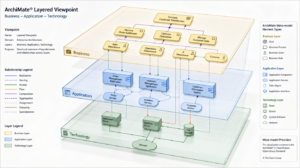
Layered notation linking strategy, business, application, and technology views.
ArchiMate for Stakeholder Views
ArchiMate is the Open Group notation for describing strategy, business, application, technology, and motivation in linked views. It matters when architects must show traceability—from capability and value stream down to application component and technology node—in a single metamodel.
Adopt ArchiMate when your repository tool supports it (Sparx EA, Bizzdesign, HOPEX, ABACUS) and when ARB packs require consistent layer notation. Keep a “minimum view set” for projects: motivation + business + application + technology, with explicit relationships rather than exhaustive decoration.
Tooling note: ArchiMate depth is a reason teams choose repository platforms over pure APM SaaS. If your organization only needs portfolio facts and transformation roadmaps, ArchiMate may be optional; if integration design and standards enforcement dominate, it is core.
What is TOGAF?
TOGAF (The Open Group Architecture Framework) is a widely adopted standard for developing and governing Enterprise Architecture. It provides methods, tools, and vocabulary—most notably the Architecture Development Method (ADM)—to help organizations design, plan, implement, and sustain architecture at enterprise scale.
What is a target-state architecture?
Target-state architecture describes the desired future structure of business capabilities, data, applications, and technology at a defined horizon. It guides portfolio decisions, sets standards, and sequences transformation—while remaining adaptable as strategy evolves.
How do you create an application roadmap?
An application roadmap sequences portfolio investments—modernization, consolidation, replacement, and retirement—over time to align technology evolution with business strategy and available delivery capacity.
What is a data domain?
A data domain is a bounded area of enterprise data governed by shared definitions, ownership, and quality standards. Data domains organize the information landscape so architects, stewards, and product teams can scale governance without treating every table as a unique problem.
How do you evaluate application technical debt?
Application technical debt is the accumulated cost of deferred maintenance, suboptimal design, and outdated technology that slows delivery and increases risk. Structured evaluation quantifies debt so architects can prioritize remediation alongside feature work.
How do you build a data architecture strategy?
A data architecture strategy translates business ambitions for data-driven operations into a coherent plan covering target models, platforms, governance, and phased implementation aligned with enterprise priorities.
How do you identify redundant applications?
Redundant applications duplicate capabilities, data, or functions across the portfolio, inflating cost and complexity. Systematic identification combines capability mapping, functional analysis, usage data, and integration patterns to surface consolidation opportunities.
What is Data Architecture?
Data architecture defines how an organization's data assets are structured, integrated, governed, and accessed to support business operations, analytics, and strategic decision-making across the enterprise.
What is application portfolio management?
Application Portfolio Management (APM) is the ongoing discipline of cataloging, evaluating, and governing an organization's application estate to maximize business value and minimize cost, risk, and complexity.