LeanIX Enterprise Architecture Review
In-depth Larkinized review of LeanIX: Gartner leadership, APM and governance modules, landscape mapping, ServiceNow integration, transformation playbooks, and when the platform earns its TCO.
Executive Summary
LeanIX Enterprise Architecture—now part of SAP—is the most frequently shortlisted SaaS platform in Larkinized LLC tool evaluations when CIOs fund EA to answer portfolio, cloud, and transformation questions at enterprise scale. Unlike repository-native tools that require months of meta-model tailoring before first value, LeanIX ships predefined architecture objects, best-practice use cases, and executive-ready views that teams can populate from discovery and owner surveys within weeks.
This review synthesizes practitioner observations across live LeanIX programs in financial services, manufacturing, healthcare, and technology—not vendor collateral. LeanIX is a broad platform: application portfolio management, technology lifecycle management, architecture roadmaps, transformation planning, integrations with ServiceNow and major cloud providers, and enablement through LeanIX Academy. It is not a drop-in replacement for deep ArchiMate engineering or GRC-unified examination repositories—but when portfolio transparency and data-driven modernization are the mandate, few platforms match its combination of speed, breadth, and market validation.
Proven Market Recognition
Gartner has positioned LeanIX as a Leader in the Magic Quadrant for Enterprise Architecture Tools for five consecutive years (2021–2026), ranking among the highest in both Completeness of Vision and Ability to Execute. That placement matters beyond analyst optics: it reflects sustained R&D investment, a large installed base, SAP enterprise distribution, and repeated proof that LeanIX executes in complex, multi-region environments—not just mid-market pilots.
Leader status does not mean LeanIX wins every scenario. Repository purists, regulated on-prem mandates, and ServiceNow-first ITSM consolidators may still choose alternatives. But when procurement committees ask whether LeanIX is a safe strategic bet, the Magic Quadrant track record, SAP balance sheet, and active customer community provide defensible answers that niche or legacy vendors struggle to match.
Fast Time-to-Value and Best-Practice Frameworks
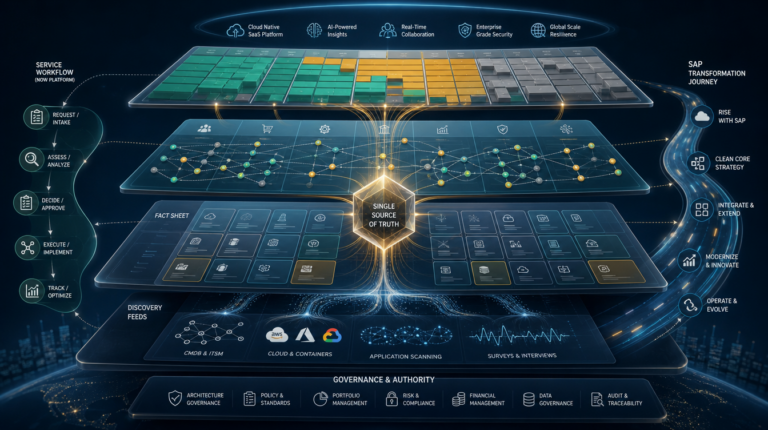
Traditional EA repositories often stall in meta-model committees for quarters before architects produce consumable output. LeanIX inverts that pattern with predefined Fact Sheet types, reference content, and packaged use cases for application rationalization, cloud transformation (including TIME-style disposition analysis), technology risk, and architecture roadmaps. Teams import discovery from ServiceNow, Flexera, Azure, AWS, Kubernetes, and other sources—or run structured owner surveys—then publish heatmaps and dependency views without building a custom ontology first.
Best-practice frameworks accelerate adoption for organizations that lack a mature modeling center of excellence. Architects still configure quality rules, stewardship roles, and integration mappings—but they start from a productized baseline rather than a blank repository. Larkinized clients typically reach first executive portfolio review within six to ten weeks when discovery sources and application owner participation are in place; timelines stretch when CMDB quality is poor or ownership is contested.
Centralized Visibility and Architecture Governance
LeanIX functions as a single source of truth for the IT and application landscape when integrations and governance are enforced. Enterprise architects, portfolio managers, security teams, and business stakeholders consume the same Fact Sheet dataset—reducing the slide-deck divergence that undermines ARB decisions and transformation funding.
- Application portfolio management — inventory applications and microservices, map dependencies, surface redundancies, and score obsolescence and criticality for rationalization waves.
- Technology lifecycle management — track technology stacks, end-of-life risk, and standard-vs-exception patterns to plan modernization and reduce unsupported component exposure.
- Architecture governance — quality metrics on Fact Sheets, approval workflows, and roadmap alignment so investments trace to business capabilities and transformation objectives.
- Collaboration and accountability — surveys and role-based access push data stewardship to application owners instead of centralizing all catalog maintenance on a small EA team.
Landscape Mapping and Portfolio Analytics
LeanIX landscape mapping visualizes relationships among applications, interfaces, technologies, business capabilities, and organizations—supporting questions that spreadsheets cannot answer reliably: What breaks if we retire this system? Which capabilities depend on obsolete middleware? Where do we have duplicate CRM or integration hubs?
Analytics layers include portfolio cost and risk views, cloud readiness and migration planning, SaaS discovery overlays, and transformation explorer scenarios for sequencing initiatives. Heatmaps resonate with executives because they translate architecture data into investment language—retire, replace, migrate, tolerate—rather than diagram aesthetics alone.
Practitioner caveat: mapping depth is portfolio- and relationship-centric, not a substitute for granular ArchiMate solution design. Teams requiring viewpoint-level rigor often pair LeanIX for facts with Sparx EA or Bizzdesign for design authority, linked through integration middleware with explicit data ownership.
Integration, Cloud Scale, and Enterprise Ecosystem
LeanIX is cloud-native and scales to large, distributed application estates. Pre-built and API-driven integrations connect to ServiceNow (CMDB, APM, and workflow patterns), major hyperscaler discovery, ITAM tools, HR systems for ownership, and SAP landscapes—reflecting its strategic position inside SAP’s transformation portfolio alongside Signavio process intelligence.
Integration maturity is a primary success factor. Organizations with authoritative ServiceNow CMDB and disciplined change management achieve seamless bidirectional sync; those with tribal-knowledge CMDBs discover LeanIX amplifies bad data loudly—which is useful if leadership funds cleanup, painful if not. Hardware and infrastructure components can be represented in technology Fact Sheets where discovery feeds exist, supporting infrastructure modernization alongside application portfolio work.
SAP alignment benefits S/4HANA and Business Suite transformation narratives; non-SAP enterprises should still evaluate LeanIX on APM merits but negotiate bundle positioning carefully to avoid paying for overlapping SAP modules they will not consume.
LeanIX Academy and Organizational Enablement
LeanIX Academy provides structured training paths for enterprise architects, portfolio managers, application owners, and administrators—reducing the “tool deployed, skills absent” failure mode common in EA programs. Certification tracks, use-case playbooks, and community content help federated teams adopt consistent Fact Sheet standards without every region reinventing guidance.
Larkinized treats Academy completion as a governance milestone, not optional onboarding: assign learning paths by role before go-live, measure survey completion rates alongside training, and tie certification to ARB submission rights where appropriate. Tools do not replace operating model design—but LeanIX invests more in enablement than many repository vendors, and clients who use it see faster owner adoption.
Alignment with Business Transformation Goals
LeanIX is purpose-built for large-scale transformation—not passive documentation. Common high-ROI programs include ERP and SAP S/4 migrations (mapping application dependencies and decommission candidates), post-merger IT integration (harmonizing duplicate portfolios across acquired entities), application modernization and cloud exit planning, SaaS sprawl control, and emerging AI governance (inventorying AI-enabled applications, data dependencies, and risk posture as portfolios evolve).
Transformation modules connect portfolio facts to initiative roadmaps, helping portfolio boards sequence funding with defensible dependency analysis. AI governance is an evolving capability area—LeanIX provides a practical inventory and relationship layer while specialized GRC or model-risk tools may still be required for algorithmic audit trails in regulated industries.
Strengths, Gaps, and Implementation Reality
Strengths: market-validated platform breadth; rapid time-to-value; executive-friendly analytics; strong discovery and ServiceNow patterns; SAP enterprise credibility; active community and Academy resources; scalable SaaS operations without repository server administration.
Gaps: ArchiMate and solution modeling depth versus Sparx or Bizzdesign; SaaS data residency and air-gapped deployment constraints for some public-sector clients; license tier cliffs at high application counts; dependency on integration and owner discipline—LeanIX exposes weak ITAM, it does not fix it silently.
Failed implementations almost always trace to operating model issues: no Fact Sheet owners, discovery synced once then abandoned, or EA buying LeanIX without funded rationalization or migration programs to act on insights. Larkinized audits readiness before purchase when clients ask us to validate fit.
Pricing and Total Cost of Ownership
Enterprise LeanIX contracts commonly range from $150,000 to $500,000+ annually depending on application tiers, transformation modules, and SAP bundle positioning. Implementation with an experienced partner typically runs eight to sixteen weeks for initial portfolio views when discovery sources exist; add three to six months when CMDB reconciliation and owner survey programs must be built from scratch.
Three-year TCO must include subscription escalation, integration FTE, discovery tool licenses feeding LeanIX, and ongoing stewardship—typically 0.5 to 1.5 FTE for mid-market, more at global scale. Larkinized models tier cliffs and overlap with SAP Signavio or ServiceNow APM so clients do not pay twice for the same portfolio narrative.
Larkinized Recommendation
Select LeanIX when portfolio transparency, cloud transformation, M&A integration, or SAP-aligned modernization are funded priorities this fiscal year—and when you will enforce owner accountability and integration hygiene. Pair with a modeling repository if ARB mandates ArchiMate deliverables your team will maintain. Consider alternatives when on-prem deployment, unified GRC examination evidence, or ServiceNow-only consolidation are non-negotiable.
Run a four-week proof of concept on your messiest domain: one rationalization wave, one migration scenario, one executive heatmap, and one ServiceNow sync. Score completion rates from application owners, not vendor demo fluency. Engage Larkinized for LeanIX readiness assessment, integration architecture, data quality playbooks, and SAP alignment reviews before contract signature.
- Gartner Magic Quadrant Leader (2021–2026) with top-tier vision and execution scores
- APM, technology lifecycle, governance, mapping, and transformation modules in one SaaS platform
- ServiceNow and cloud discovery integrations plus LeanIX Academy enablement
- ROI depends on owner accountability, integration quality, and funded transformation programs
LeanIX Capability and Value Map
Platform layers from discovery and Fact Sheets through portfolio analytics, transformation roadmaps, ServiceNow integration, and executive governance views.
Need Expert Guidance?
Larkinized LLC helps organizations design, govern, and execute enterprise architecture programs that deliver measurable business outcomes.